Edexcel IGCSE Biology revision

Characteristics of living organisms questions

Recognise the processes shared by living things, from nutrition and respiration to growth and reproduction.

Edexcel IGCSE Biology Subtopic 1.a

Characteristics of living organisms syllabus

Questions on characteristics of living organisms can test recall, calculations, explanations, diagrams, data handling and practical skills. You should be able to:

  • 1.1 explain how living organisms share these characteristics:
    • nutrition, respiration and excretion of waste;
    • responding to their surroundings and movement;
    • control of internal conditions;
    • reproduction, growth and development.

How to answer characteristics of living organisms questions

  1. Identify the characteristic or organism group being tested before selecting biological features.
  2. Use named examples and precise cellular or nutritional features when making comparisons.
  3. Follow the command word: state briefly, describe what is observed, and explain using linked biology.
  4. Support conclusions with evidence from any diagram, table or experimental result provided.

Characteristics of living organisms example questions and worked answers

These examples show how information in a diagram, graph or experimental context becomes part of a complete exam answer.

Example 1: Matching life processes to their meanings

Adapted from June 2015, Paper 1B · Question 1

Question 1

Living organisms share some basic characteristics.

Draw a straight line from each characteristic to its correct description.
The first has been done for you.
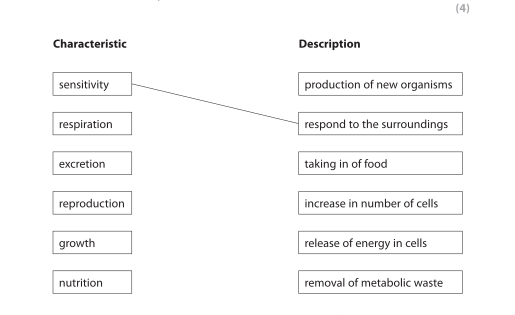
Matching diagram listing the characteristics sensitivity, respiration, excretion, reproduction, growth and nutrition, alongside descriptions including responding to the surroundings, taking in of food, increase in number of cells, release of energy in cells, removal of metabolic waste and production of new organisms.

Final answer

The correct matches are shown below. The sensitivity match is already given.

Characteristic Description sensitivity respiration excretion reproduction growth nutrition production of new organisms respond to the surroundings taking in of food increase in number of cells release of energy in cells removal of metabolic waste

Mark scheme points

The five new matches are assessed together, rather than earning one mark each.

  1. M1 Respiration → release of energy in cells.
  2. M2 Excretion → removal of metabolic waste.
  3. M3 Reproduction → production of new organisms.
  4. M4 Growth → increase in number of cells.
  5. M5 Nutrition → taking in of food.

Scoring: 5 correct matches = 4 marks; 4 correct = 3 marks; 3 or 2 correct = 2 marks; 1 correct = 1 mark. The given sensitivity match does not count towards these totals.

Explanation

Draw one straight line from each remaining characteristic. Check the meaning of each process:

  • Respiration: chemical reactions in cells release energy from nutrients.
  • Excretion: metabolic waste means waste produced by chemical reactions in the body, such as carbon dioxide.
  • Reproduction: organisms produce offspring—new organisms.
  • Growth: cell division increases the number of cells in a multicellular organism.
  • Nutrition: taking in food supplies nutrients needed by the organism.

Crossing lines are fine: check where each line ends.

Common mistakes

  • Do not confuse respiration with breathing. Respiration releases energy in cells.
  • Do not confuse excretion with egestion. Excretion removes metabolic waste; egestion removes undigested food.

Example 2: Why bees collect nectar

Adapted from June 2014, Paper 2B · Question 1(b)

Question 2

Bees visit flowers to collect a sweet substance called nectar and take it back to their hive.

Black-and-white photograph of many bees clustered together.

Photographer: Eigene Aufnahme, August 2006

Some of the nectar is used to make honey.

Suggest why the bees collect nectar.

Final answer

Bees collect nectar to make honey, and its sugars provide energy for respiration.

Mark scheme points

  1. M1 Nectar is used to make honey or as food.
  2. M2 Nectar contains sugar, such as sucrose, glucose or fructose.
  3. M3 Nectar provides energy or is used in respiration.

Any two of these three points are needed for the two marks.

Explanation

Nectar is a food source that bees use to make honey. Its sugars can also be used in respiration, which releases energy for the bees.

Common mistakes

  • Do not write only “carbohydrate”: that alone is ignored. Name a sugar or explain that nectar provides energy or is used in respiration.

Practise Characteristics of living organisms questions

Build a focused practice set from this part of the Edexcel IGCSE Biology syllabus.