Example 1: Using a Diagram
Question 1
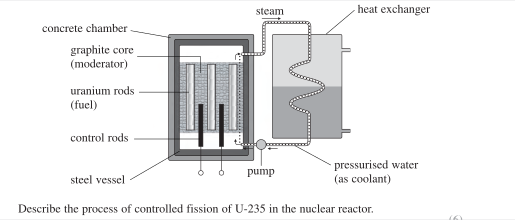
Describe the process of controlled fission of U-235 in the nuclear reactor.
Final answer
A neutron is absorbed by a nucleus of U-235, making it unstable. The nucleus splits into two smaller daughter nuclei, releasing energy and further neutrons. These neutrons can cause more U-235 nuclei to split, producing a chain reaction.
The moderator slows down the neutrons, increasing the likelihood of further fissions. Control rods absorb neutrons; inserting or removing them controls the rate of the chain reaction. The energy released heats the water coolant, and the heat is transferred in the heat exchanger to produce steam.
Mark scheme points
Any six of the following points can earn the six marks:
- M1 A neutron is captured or absorbed by a U-235 nucleus, producing an unstable state.
- M2 The nucleus breaks up into smaller daughter nuclei.
- M3 Energy is released.
- M4 Neutrons are released.
- M5 The released neutrons can cause further fissions.
- M6 This produces a chain reaction.
- M7 The moderator slows the neutrons, increasing the likelihood or rate of fission.
- M8 Control rods absorb neutrons and reduce the reaction rate.
- M9 The control rods can be inserted or removed to control the reaction.
- M10 The released energy is used to heat water.
- M11 Heat is transferred to another part of the system, such as through a heat exchanger.
Explanation
For the fission event, identify the particle as a neutron and the material splitting as the U-235 nucleus. State both the products of fission and the released energy. The released neutrons maintain the chain reaction by causing further fissions.
Controlled means that the reaction rate is adjusted: the moderator slows neutrons, while control rods absorb neutrons. Finally, link the nuclear energy to the power station by explaining that it heats water and that the heat is transferred to produce steam.
Common mistakes
- Writing that electrons are absorbed or released. The particles involved in the chain reaction are neutrons.
- Saying that a whole atom, molecule or cell undergoes fission. It is the U-235 nucleus that splits.
- Describing only one fission and omitting that released neutrons cause further fissions in a chain reaction.
- Confusing the roles of the moderator and control rods: the moderator slows neutrons, while control rods absorb them.
- Stopping at “energy is released” without explaining that it heats water and is transferred for steam production.
![Nuclear equation with blanks: ²₁H + ³₁H → [blank]₂He + ¹[blank]n. Student must fill missing mass number for helium and atomic number for neutron.](/revision/assets/physics/edexcel-igcse-physics-fission-and-fusion-questions/example-2-img-p19-1.svg)