Edexcel IGCSE Biology revision

Cloning questions

Follow the stages of cloning in plants and animals, and distinguish nuclear transfer from genetic modification.

Edexcel IGCSE Biology Subtopic 5.d

Cloning syllabus

Questions on cloning can test recall, calculations, explanations, diagrams, data handling and practical skills. You should be able to:

  • 5.17B describe micropropagation (tissue culture), in which explants are grown in vitro.
  • 5.18B explain how micropropagation produces commercial quantities of genetically identical plants with desirable characteristics.
  • 5.19B describe cloning a mammal by transferring a diploid nucleus from a mature cell into an enucleated egg cell, illustrated by Dolly the sheep.
  • 5.20B explain how cloned transgenic animals can be used to produce human proteins.

How to answer cloning questions

  1. Describe each stage of the biological technique in order and name the cells, enzymes or vectors involved.
  2. Distinguish selective breeding, genetic engineering and cloning before comparing their outcomes.
  3. Balance a stated benefit against a specific biological, environmental or ethical limitation.
  4. Use evidence from the question when evaluating yield, disease resistance, biodiversity or food security.

Cloning example questions and worked answers

These examples show how information in a diagram, graph or experimental context becomes part of a complete exam answer.

Example 1: Identifying stages in nuclear transfer

Adapted from June 2017 (R), Paper 2B · Question 2(b)

Question 1

Spiders produce silk to make webs to catch their prey.

A spider hanging below a web.

Spider silk can be used to make clothes.

Scientists have produced transgenic goats that have spider silk in their milk.

The diagram shows the stages needed to produce these transgenic goats.
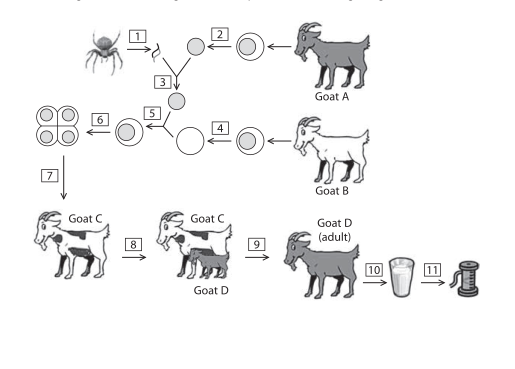
Numbered diagram showing stages 1 to 11 involving a spider gene, goat A and goat B cells, an embryo, goats C and D, milk and silk.

The table describes stages in this diagram.

Complete the table by matching each description to its correct stage number in the diagram.

Each number may be used once, more than once or not at all.

One has been done for you.

Description of stage Stage number
cutting a gene 1
cell division by mitosis to produce an embryo
implantation into a surrogate mother
enucleation of a haploid cell
production of milk containing silk
use of an electric shock

Final answer

Description of stage Stage number
Cutting a gene1
Cell division by mitosis to produce an embryo6
Implantation into a surrogate mother7
Enucleation of a haploid cell4
Production of milk containing silk10
Use of an electric shock5

Stage 6 is also accepted for the electric shock; stages 5 and 6 together are accepted too.

Mark scheme points

  1. M1 Cell division by mitosis to produce an embryo: stage 6 only.
  2. M2 Implantation into a surrogate mother: stage 7 only.
  3. M3 Enucleation of a haploid cell: stage 4 only.
  4. M4 Production of milk containing silk: stage 10 only.
  5. M5 Use of an electric shock: stage 5 or stage 6, or stages 5 and 6 only.

Explanation

Stage 4 is the removal of the nucleus from the haploid egg cell. The electric shock is shown at stage 5; stage 6 is also accepted for this description.

The resulting cell divides by mitosis to form an embryo at stage 6. The embryo is implanted into a surrogate mother at stage 7. Later, the transgenic goat produces milk containing silk at stage 10.

Common mistakes

  • Do not confuse enucleation at stage 4 with the electric shock at stage 5 or 6.
  • Keep the stages in order: implantation is stage 7, while production of milk containing silk is stage 10.
Example 2: Completing the stages of tiger cloning

Adapted from January 2012, Paper 2B · Question 2

Question 2

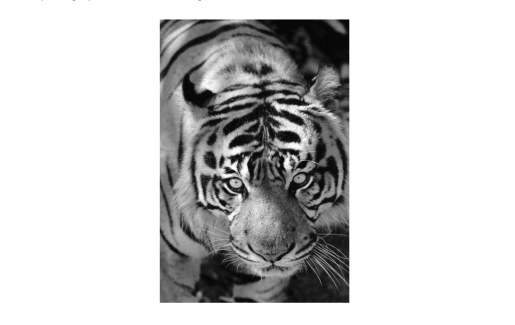
The photograph shows a Siberian tiger.

Photograph of a Siberian tiger.

Siberian tigers are very rare and are in danger of becoming extinct. Scientists hope to use cloning as a method to increase the number of Siberian tigers.

The passage below describes the process of cloning. Complete each gap with a suitable word.

A nucleus is taken from a body of an adult Siberian tiger.

This nucleus is put into an enucleated cell, a cell that has had its nucleus removed. The cell is given a mild electric shock to help it divide by a type of cell division called .

A ball of cells is produced called an . The ball of cells is placed into the of a female Bengal tiger. This female tiger is called a mother.

Final answer

A nucleus is taken from a body cell of an adult Siberian tiger. This nucleus is put into an enucleated egg cell. The cell is given a mild electric shock to help it divide by mitosis. A ball of cells called an embryo is produced. The embryo is placed into the uterus of a female Bengal tiger, called a surrogate mother.

Mark scheme points

  1. M1 The nucleus comes from a body cell (an udder cell is also accepted).
  2. M2 The nucleus is placed into an egg, ovum or sex cell that has had its nucleus removed.
  3. M3 The cell divides by mitosis; meiosis is not accepted.
  4. M4 The ball of cells is called an embryo.
  5. M5 The embryo is placed in the uterus or womb.
  6. M6 The female carrying the embryo is called a surrogate mother.

Explanation

The nucleus is taken from a body cell and put into an egg cell whose own nucleus has been removed. An electric shock stimulates the cell to divide by mitosis, producing a ball of cells called an embryo. The embryo is placed in the uterus of a surrogate mother, where it can develop.

Common mistakes

  • Do not write meiosis: the cell divides by mitosis.
  • Do not confuse the egg cell with the uterus: the nucleus goes into the egg cell, while the embryo is placed in the uterus.

Practise Cloning questions

Build a focused practice set from this part of the Edexcel IGCSE Biology syllabus.