Example 1: Evaluating evidence for fertiliser pollution
Adapted from November 2020 (R), Paper 1B · Question 10(b)
Question 1
Farmers may add chemical fertilisers to their soil.
These fertilisers may leak into rivers.
A scientist measures the oxygen content of water in two different locations of the same river during the month of April.
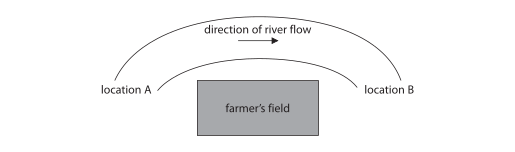
In location A he finds that the mean dissolved oxygen was 6 mg per litre and at location B he finds that the mean dissolved oxygen was 3 mg per litre.
He concludes that the use of fertiliser in the field has affected the oxygen content of the river.
Discuss his conclusion.
Final answer
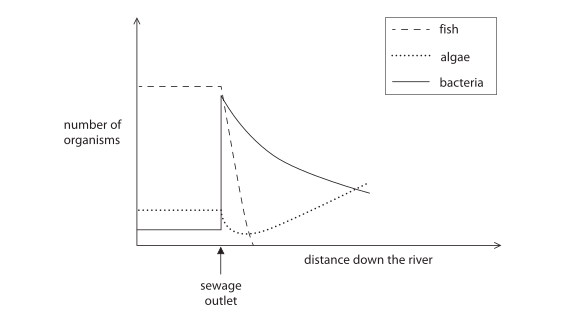
Fertiliser from the field could be washed into the river and cause an algal bloom. When the algae die, bacteria decompose them and respire, using dissolved oxygen. The lower mean oxygen content at location B (3 mg per litre, compared with 6 mg per litre at A), downstream of the field, supports the scientist’s conclusion. However, other factors or fertiliser from other fields could also have caused the decrease, so the results do not prove that this field’s fertiliser was responsible.
Mark scheme points
Any four of the following points are needed for the 4 marks; the alternatives are not all required.
- M1 Fertiliser leaches or is washed from the field into the river.
- M2 Fertiliser causes algal or plant growth, an algal bloom, or eutrophication.
- M3 Dead algae are decomposed or broken down by bacteria or other decomposers.
- M4 Bacterial respiration reduces the oxygen content of the water.
- M5 Means are calculated or readings are repeated, supporting reliability or validity.
- M6 Measurements are taken at the same time of year, in April, supporting a valid comparison.
- M7 The river flows past the farm between locations A and B.
- M8 Other factors or fertiliser from other fields could also explain the reduced oxygen.
Explanation
Fertiliser can leach into the river and supply minerals that encourage algae to grow. When the algae die, decomposers break them down. The decomposers respire and use oxygen dissolved in the water, which can lower its oxygen content.
Location B is downstream of the field, and its mean oxygen content is lower than at A, so the results are consistent with this process. But the comparison alone cannot show that the fertiliser from this particular field caused the decrease: other factors or fertiliser sources could also affect the river.
Common mistakes
- Do not say that algae consume the oxygen. Explain that bacteria or other decomposers break down dead algae and use oxygen in respiration.
- Do not claim that the difference proves the field’s fertiliser caused the decrease; acknowledge that other factors or fertiliser sources may be involved.