Edexcel IGCSE Physics revision

Edexcel IGCSE Physics Electric charge questions

Revise the syllabus content for Electric charge, learn how to approach common exam questions, and study two worked examples with clear diagrams.

Edexcel IGCSE Physics Subtopic 2.d

Electric charge syllabus

Questions on electric charge can test recall, calculations, explanations, diagrams, data handling and practical skills. You should be able to:

  • 2.22P identify common materials that are electrical conductors or insulators, including metals and plastics
  • 2.23P practical: investigate how insulating materials can be charged by friction
  • 2.24P explain how positive and negative electrostatic charges are produced on materials by the loss and gain of electrons
  • 2.25P know that there are forces of attraction between unlike charges and forces of repulsion between like charges
  • 2.26P explain electrostatic phenomena in terms of the movement of electrons
  • 2.27P explain the potential dangers of electrostatic charges, e.g. when fuelling aircraft and tankers
  • 2.28P explain some uses of electrostatic charges, e.g. in photocopiers and inkjet printers

How to answer electric charge questions

  1. Identify whether the circuit is series or parallel before combining currents, voltages or resistances.
  2. Draw standard circuit symbols cleanly and place ammeters in series and voltmeters in parallel.
  3. Show unit conversions, especially milliamps, kilohms, kilowatt-hours and seconds.
  4. In explanations, follow charge or energy through the circuit rather than only naming a rule.

Electric charge example questions and worked answers

These examples show how information in a diagram, graph or experimental context becomes part of a complete exam answer.

Example 1: Reading an Experimental Diagram

Question 1
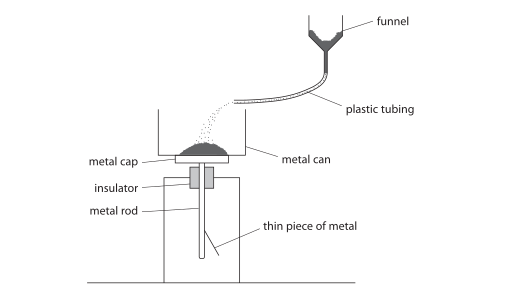
A student uses this apparatus to demonstrate the effect of electric charge.
Diagram of an electrostatic charging apparatus: fine powder poured into a funnel passes through plastic tubing and falls into a metal can on a metal cap. The cap is connected via a metal rod through an insulator to a thin piece of metal (leaf) near the rod.
He pours some fine powder into a funnel.
The fine powder moves through a length of plastic tubing and falls into a metal can.
The metal can rests on a metal cap.
The metal cap is connected to a thin piece of metal via a metal rod.
When the powder lands in the can, the thin piece of metal moves away from the metal rod.
The student suggests that this demonstration is similar to refuelling an aircraft.
The powder represents the fuel and the metal can represents the fuel tank in the aircraft.
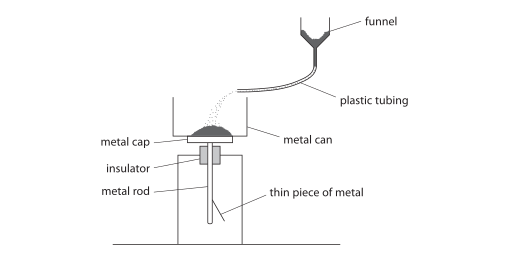
Diagram of the same electrostatic charging apparatus used to represent refuelling: powder through funnel and plastic tubing into a metal can on a metal cap, connected to a metal rod and thin metal leaf via an insulator.
Explain how the student should modify this apparatus to demonstrate how to minimise the dangers when refuelling an aircraft.
You may add to the diagram to help your answer.


Final answer

Connect the metal can, representing the aircraft’s fuel tank, to the ground using a conducting wire. Any charge can then flow to or from the ground, so charge does not build up on the tank. This reduces the risk of a spark causing a fire or explosion.

Mark scheme points

Any three of the following points earn the three marks:

  1. M1 Identify a danger, such as a spark causing a fire or explosion.
  2. M2 Earth the metal can or aircraft by connecting it to the ground with a wire.
  3. M3 Charge can flow to or from the ground.
  4. M4 No charge builds up on the metal can or aircraft.

Explanation

The important modification is to add an earth connection to the metal can, which represents the aircraft’s metal fuel tank. Earthing provides a conducting path between the tank and the ground. Electrons can therefore flow either towards or away from the ground, depending on the charge on the tank.

This prevents a large electrostatic charge from building up. Without earthing, a spark could jump during refuelling and ignite fuel vapour, causing a fire or explosion.

  • Add a conducting wire from the metal can to the ground.
  • State that charge flows to or from the ground.
  • Link this to preventing charge build-up and reducing the risk of sparks.

Common mistakes

  • Do not just say that the metal can is a conductor; it must be connected to the ground.
  • Make the safety connection to the metal can or aircraft, not only to the plastic tubing.
  • State a specific hazard, such as a spark causing fire or explosion.
  • Do not say that charge can only flow away from the aircraft; it may flow to or from the ground.
  • Examiners reported that earthing and the possible hazards were recalled very well, including that charge flows either away from or towards the ground through the wire.
Example 2: Using a Diagram

Question 2

*P71958RA0624*
6

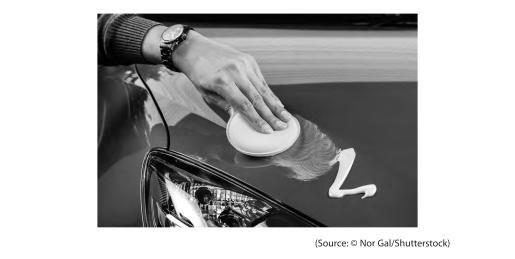
A cleaning product is applied to a car using a sponge pad.
The sponge pad is rubbed against the car to apply the cleaning product.
Photograph of a hand holding a sponge pad rubbing the surface of a car to apply a cleaning product.
*P71958RA0724* Turn over
7

The sponge pad is held near a metal post that is connected to the ground.
The sponge pad discharges with a small spark through the air to the metal post.
The small spark between the sponge pad and the metal post demonstrates
that the sponge pad is charged.
Describe a different experiment that could demonstrate that the sponge pad
is charged.
You may draw a diagram to support your answer.


Final answer

Place small pieces of paper on a table and bring the sponge pad close to them without touching. If the paper pieces are attracted to the sponge pad, this shows that the sponge pad is charged.

Mark scheme points

  1. M1 Bring the sponge pad near another uncharged insulator, such as small pieces of paper.
  2. M2 The insulator is attracted to the sponge pad, demonstrating that the sponge pad is charged.

Explanation

Use a test object that is initially uncharged. Small pieces of paper are suitable insulators. When the charged sponge is brought close, the paper is attracted to it. This attraction provides evidence that the sponge carries electrostatic charge.

  • Use an uncharged insulator.
  • State that it is attracted to the sponge.
  • Link the attraction to the sponge being charged.

Common mistakes

  • Rubbing the sponge with another insulator is not, by itself, a test that demonstrates the sponge is charged.
  • The test object should be uncharged initially; do not use another charged insulator.
  • State attraction, not repulsion, when using paper pieces or a water stream. Repulsion is accepted only when linked to a gold-leaf electroscope.
  • Examiners reported that bringing the sponge near small pieces of paper and observing attraction was sufficient for both marks. Many candidates using a thin water stream incorrectly stated that the water was repelled, losing the second mark.

Practise Electric charge questions

Build a focused practice set from this part of the Edexcel IGCSE Physics syllabus.