Edexcel IGCSE Physics revision

Edexcel IGCSE Physics Astrophysics units questions

Revise the syllabus content for Astrophysics units, learn how to approach common exam questions, and study two worked examples with clear diagrams.

Edexcel IGCSE Physics Subtopic 8.a

Astrophysics units syllabus

Questions on astrophysics units can test recall, calculations, explanations, diagrams, data handling and practical skills. You should be able to:

  • 8.1 use the following units: kilogram (kg), metre (m), metre/second (m/s), metre/second² (m/s²), newton (N), second (s), newton/kilogram (N/kg)

How to answer astrophysics units questions

  1. Write the unit symbol exactly and distinguish quantities that use similar-looking units.
  2. Convert prefixes and compound units before substituting values into an equation.
  3. Check that the unit of the final answer matches the quantity asked for.
  4. Use the context of a diagram or calculation to reject units with the wrong dimensions.

Astrophysics units example questions and worked answers

These examples show how information in a diagram, graph or experimental context becomes part of a complete exam answer.

Example 1: Using a Diagram

Question 1

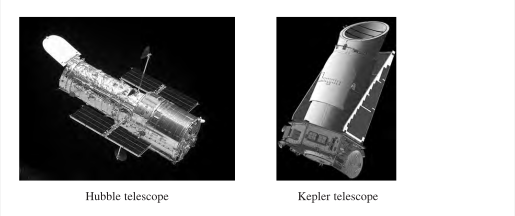
Hubble and Kepler are the names of two space telescopes. Photograph of the Hubble space telescope. Photograph of the Kepler space telescope. Gravitational field strength is measured in
A kg/N
B kg/N2
C N/kg
D N/kg2

Final answer

C – N/kg

Mark scheme points

  1. M1 Selects C – N/kg.

Explanation

Gravitational field strength is the force acting per unit mass:

g = F / m
unit of g = N / kg = N/kg

Therefore, the correct unit is N/kg.

Common mistakes

  • Do not choose kg/N; this is the reciprocal of the required unit.
  • Do not use N/kg2; gravitational field strength involves force divided by mass only.
  • Remember that the unit of force is N and the unit of mass is kg.

Example 2: Applying Physics

Question 2

A star has a circular orbit around the centre of a galaxy.
*P73427A02336* Turn over
23

The speed of light is 3.0×10⁸m/s.
One light year is the distance light travels in one year.
Show that one light year is approximately 1016m.
[one year = 3.2×10⁷ s]

Final answer

distance = speed × time
         = (3.0 × 108) × (3.2 × 107)
         = 9.6 × 10¹⁵ m
         ≈ 1.0 × 10¹⁶ m

Mark scheme points

  1. M1 Use distance = average speed × time.
  2. M2 Evaluate correctly to at least 2 significant figures: 9.6 × 10¹⁵ m.

Explanation

A light year is the distance travelled by light, so use:

distance = speed × time

Substitute the speed of light and the number of seconds in one year. When multiplying powers of ten, add their indices:

108 × 107 = 1015

Therefore, one light year is 9.6 × 10¹⁵ m, which is approximately 1016 m. Include the unit metres.

Common mistakes

  • Do not divide speed by time; distance is found using speed × time.
  • When multiplying powers of ten, add the powers: 8 + 7 = 15.
  • Do not give only 1016 m without showing the evaluated value 9.6 × 10¹⁵ m.
  • Examiners reported that most candidates showed the derivation successfully, but some lost the final mark by not evaluating the answer to at least 2 significant figures.

Practise Astrophysics units questions

Build a focused practice set from this part of the Edexcel IGCSE Physics syllabus.