Example 1: Using a Diagram
Question 1
*P71957A02224*
22
Concrete on top of buildings can be used to heat water.
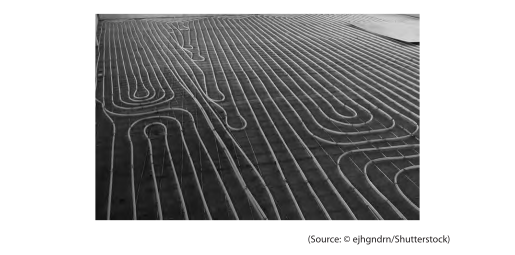
The photograph shows a concrete and water heating system being built into the roof of a house.
*P71957A02324* 23
A scientist wants to determine the specific heat capacity of concrete.
The diagram shows some of the equipment they could use.
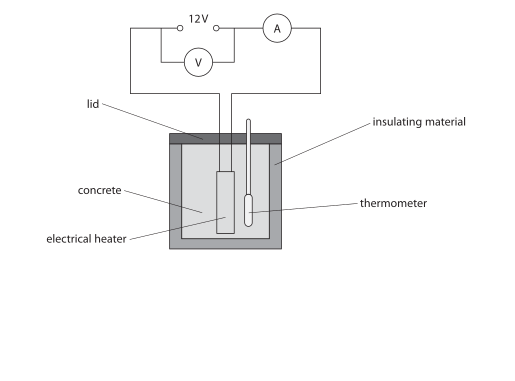
Describe a suitable method to find the specific heat capacity of concrete.
Final answer
- Measure the mass, m, of the concrete block using a balance.
- Measure the potential difference, V, across the heater and the current, I, through it. Use a stopwatch to measure the heating time, t.
- Record the initial and final temperatures and calculate the temperature change: ΔT = final temperature − initial temperature.
- Calculate the electrical energy supplied: E = V × I × t.
- Calculate the specific heat capacity using c = E ÷ (m × ΔT).
- Repeat the experiment and calculate an average value.
Mark scheme points
Any five of the following points earn the marks:
- M1 Measure the mass of the concrete using a balance.
- M2 Measure the heating time using a timer or stopwatch.
- M3 Calculate ΔT = final temperature − initial temperature.
- M4 Calculate energy supplied using E = voltmeter reading × ammeter reading × time.
- M5 Rearrange the equation to give c = energy supplied ÷ (m × temperature change).
Explanation
The mass must be measured because specific heat capacity is defined per kilogram. The electrical power supplied to the heater is V × I, so the energy transferred in time t is:
E = V × I × t
ΔT = Tfinal − Tinitial
c = E ÷ (m × ΔT)
Use the readings from the voltmeter and ammeter rather than quoting only the supply voltage. Repeating the experiment and averaging reduces the effect of random measurement errors.
Common mistakes
- Quoting the specific heat capacity equation without rearranging it to calculate c.
- Omitting the measured mass of the concrete.
- Using only the heater voltage and ignoring the current and heating time when finding energy.
- Failing to state how the temperature change is found.
- Examiners reported that full-mark responses measured the mass, energy and temperature rise and made specific heat capacity the subject of the equation; merely quoting the equation was insufficient.