Edexcel IGCSE Physics revision

Edexcel IGCSE Physics Density and pressure questions

Revise the syllabus content for Density and pressure, learn how to approach common exam questions, and study two worked examples with clear diagrams.

Edexcel IGCSE Physics Subtopic 5.b

Density and pressure syllabus

Questions on density and pressure can test recall, calculations, explanations, diagrams, data handling and practical skills. You should be able to:

  • 5.3 know and use the relationship between density, mass and volume: density = mass / volume ρ = m / V
  • 5.4 practical: investigate density using direct measurements of mass and volume
  • 5.5 know and use the relationship between pressure, force and area: pressure = force / area p = F / A
  • 5.6 understand how the pressure at a point in a gas or liquid at rest acts equally in all directions
  • 5.7 know and use the relationship for pressure difference: pressure difference = height × density × gravitational field strength p = h × ρ × g

How to answer density and pressure questions

  1. Sketch or describe particle spacing, arrangement and motion before explaining bulk behaviour.
  2. Convert volumes and temperatures carefully; gas-law temperatures must be in kelvin.
  3. State which variables are fixed when describing pressure-volume or pressure-temperature changes.
  4. For practical methods, identify direct measurements, repeated readings and the calculation used.

Density and pressure example questions and worked answers

These examples show how information in a diagram, graph or experimental context becomes part of a complete exam answer.

Example 1: Using a Diagram

Question 1

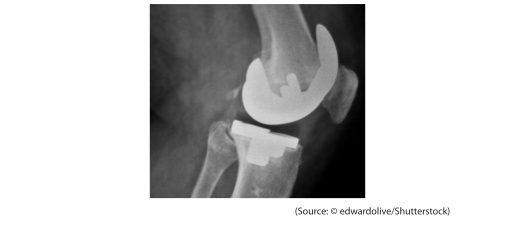
The photograph shows an x-ray image of a person’s knee. The person has had part of their knee replaced.
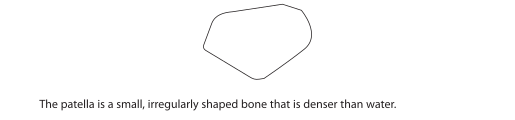
(Source: © edwardolive/Shutterstock) X-ray image of a knee showing a knee replacement implant. The diagram shows a part of the knee called the patella. The patella has been removed from a person’s knee.
The patella is a small, irregularly shaped bone that is denser than water.
Describe how to find the mass and the volume of the patella bone. Simple outline diagram of an irregularly shaped patella (bone) used to indicate an object whose volume would be measured by displacement.
Final answer

Use a zeroed balance on a flat surface to measure the mass of the dry patella.

Put a known volume of water in a measuring cylinder and record the initial volume. Completely submerge the patella without splashing and record the final volume. The volume of the patella is:

volume of patella = final volume − initial volume

Read the measuring cylinder at eye level and ensure that no water is lost.

Mark scheme points

  1. M1 Use a balance to measure mass and a measuring cylinder to measure volume.
  2. M2 Use water displacement to determine the volume of the irregular bone.
  3. M3 Record the initial and final water volumes and calculate their difference.
  4. M4 Include a valid accuracy detail, such as reading the measuring cylinder at eye level, avoiding splashing, or ensuring the bone is totally submerged.

Explanation

A balance directly measures the mass. A ruler cannot be used to find the volume because the patella has an irregular shape.

The bone is denser than water, so it will sink and can be completely submerged. Submerging it raises the water level by an amount equal to the bone’s volume. Therefore, subtracting the initial reading from the final reading gives the volume.

  • Mass: use a balance, preferably with the dry bone and the balance zeroed.
  • Volume: use water displacement in a measuring cylinder.
  • Accuracy: avoid splashing or trapped air and read the scale at eye level.

Common mistakes

  • Do not just describe finding density; the question asks specifically how to measure mass and volume.
  • Do not use a ruler for this irregularly shaped bone.
  • Do not omit either the initial or final water reading, or the subtraction of the two readings.
  • Do not leave the bone partly submerged or allow water to splash out.
  • Examiners reported that many candidates chose displacement but lost marks by giving too little detail or omitting essential apparatus, especially the measuring cylinder and a valid accuracy detail.
Example 2: Using a Diagram

Question 2

John Leslie was a scientist who investigated heat and thermometers.
He experimented with a hollow metal cube. The cube had different surfaces on each side and was filled with boiling water.
John Leslie also invented a differential thermometer.
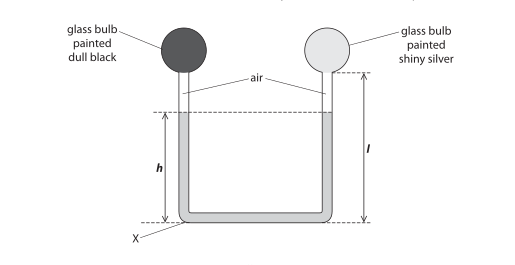
The diagram shows this thermometer.
The bulbs are filled with air and are connected by a tube which contains liquid.
Diagram of a differential thermometer: two glass bulbs at the top connected by a U-shaped tube containing liquid. One bulb is painted dull black and the other shiny silver. A height difference h between liquid levels is shown and a point X at the bottom of one column is marked. The tube length l is indicated on one side; air is shown above the liquid in both sides.
QUESTION 9 CONTINUES ON THE NEXT PAGE
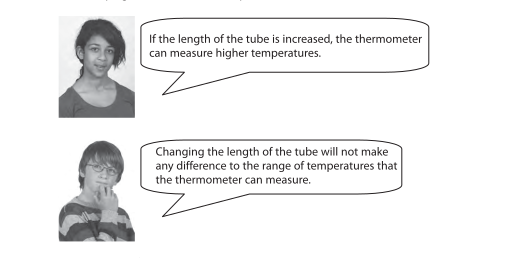
Two students discuss the effect of changing the length, l, of the tube on both sides, while keeping the total volume of liquid constant.
Photo/illustration of two students with speech bubbles. Student 1 says: 'If the length of the tube is increased, the thermometer can measure higher temperatures.' Student 2 says: 'Changing the length of the tube will not make any difference to the range of temperatures that the thermometer can measure.'
Explain which of these ideas is correct.

Final answer

Student 1 is correct. Increasing the length of the tube gives a larger temperature range because the liquid levels can move through a greater distance, producing a larger difference in level or air volume before the liquid reaches a bulb.

Mark scheme points

  1. M1 Increasing the tube length gives a bigger temperature range.
  2. M2 A suitable reason: it allows a larger difference in liquid level or air volume before the liquid reaches a bulb.

Explanation

The longer tube provides more distance for the liquid levels to move. Therefore, a greater change in liquid level and air volume can occur before the liquid reaches either bulb. The thermometer can consequently measure higher temperatures, so its temperature range is increased.

  • Identify Student 1 as correct.
  • State that the temperature range is bigger.
  • Explain this using the greater possible change in liquid level or air volume.

Common mistakes

  • Choosing Student 2 earns no marks.
  • Only stating that the tube is longer, without linking this to a bigger temperature range, is incomplete.
  • Do not say that the amount of liquid increases; its total volume is kept constant.
  • Do not omit the reason, such as the larger possible difference in liquid level or air volume before the liquid reaches a bulb.

Practise Density and pressure questions

Build a focused practice set from this part of the Edexcel IGCSE Physics syllabus.