Edexcel IGCSE Physics revision

Edexcel IGCSE Physics Solids, liquids and gases units questions

Revise the syllabus content for Solids, liquids and gases units, learn how to approach common exam questions, and study two worked examples with clear diagrams.

Edexcel IGCSE Physics Subtopic 5.a

Solids, liquids and gases units syllabus

Questions on solids, liquids and gases units can test recall, calculations, explanations, diagrams, data handling and practical skills. You should be able to:

  • 5.1 use the following units: degree Celsius (°C), Kelvin (K), joule (J), kilogram (kg), kilogram/metre³ (kg/m³), metre (m), metre² (m²), metre³ (m³), metre/second (m/s), metre/second² (m/s²), newton (N) and pascal (Pa)
  • 5.2P use the following unit: joules/kilogram degree Celsius (J/kg °C)

How to answer solids, liquids and gases units questions

  1. Write the unit symbol exactly and distinguish quantities that use similar-looking units.
  2. Convert prefixes and compound units before substituting values into an equation.
  3. Check that the unit of the final answer matches the quantity asked for.
  4. Use the context of a diagram or calculation to reject units with the wrong dimensions.

Solids, liquids and gases units example questions and worked answers

These examples show how information in a diagram, graph or experimental context becomes part of a complete exam answer.

Example 1: Using a Diagram

Question 1

6
*P40138A0632*

2 A student measures the density of water.

She uses a measuring cylinder and an electronic balance.
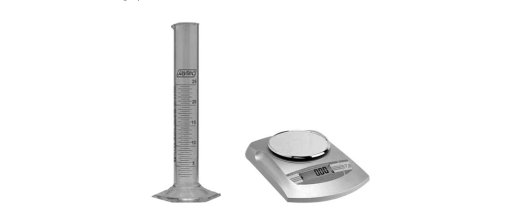
Photograph of a measuring cylinder and an electronic balance (digital scale) used to measure volume and mass when finding density.
7
*P40138A0732*
Turn over

A correct unit for density is

A  g/cm
B  kg/cm
C  g/cm2
D  g/cm3

Final answer

D   g/cm3

Mark scheme points

  1. M1 Selects D, g/cm3.

Explanation

Density is calculated using:

density = mass ÷ volume

Mass can be measured in grams (g), and volume is measured in cubic centimetres (cm3). Therefore, the unit is g/cm3.

Common mistakes

  • Do not use cm, because volume must be measured in cubic centimetres: cm3.
  • Do not use cm2; this is a unit of area, not volume.
  • Remember that density is mass divided by volume, so the units are written as mass per unit volume.

Example 2: Core Knowledge

Question 2

A student wants to calculate the pressure he exerts on the floor when he stands on one foot.
He records these measurements.
My weight 650
Area of the floor in contact with my foot 270 cm2
Complete the table by adding the unit for weight.

Final answer

newtons (N)

Mark scheme points

  1. M1 Correct unit for weight: N or newtons.

Explanation

Weight is a force. The SI unit of force, and therefore of weight, is the newton, written N. The table should therefore show the weight as 650 N.

Common mistakes

  • Do not use kg; kilograms are used for mass, not weight.
  • Do not use Pa; pascals are used for pressure.
  • Write the correct symbol as an uppercase N, not n or Ns.

Practise Solids, liquids and gases units questions

Build a focused practice set from this part of the Edexcel IGCSE Physics syllabus.