Example 1: Using a Diagram
Question 1
The flask is no longer being heated.
The egg seals the flask so that no air escapes.
Photograph 3 shows the egg and the flask a short time later.
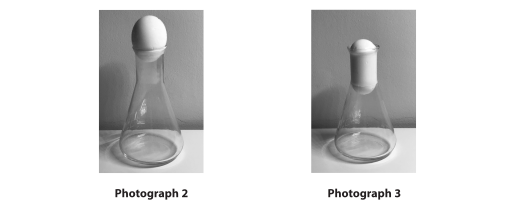
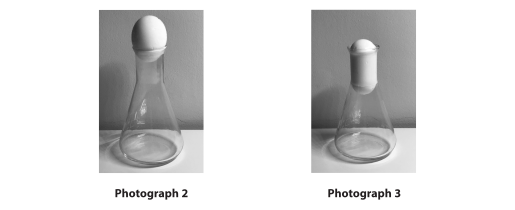 Explain why the egg moves down into the flask and then stops moving.
Refer to ideas about pressure in your answer.
Final answer
The air trapped in the flask cools, so the molecules move more slowly and the pressure inside the flask decreases. The pressure outside the flask is then greater than the pressure inside, producing a resultant force that pushes the egg down into the flask. As the egg moves down, the volume of trapped air decreases, so its pressure increases. Eventually, the pressure inside equals the pressure outside, so there is no resultant force and the egg stops moving.
Mark scheme points
Any four of the following points earn the four marks:
- M1 The air in the flask cools.
- M2 The molecules move more slowly, so their average kinetic energy decreases.
- M3 The pressure inside the flask decreases as the temperature decreases.
- M4 The pressure outside the flask becomes greater than the pressure inside.
- M5 The resultant force from the air pushes the egg down the neck of the flask.
- M6 The volume of air in the flask decreases as the egg moves down.
- M7 The pressure inside the flask increases as the volume decreases.
- M8 Eventually, the pressure inside and outside the flask becomes equal.
- M9 The resultant force becomes zero, so the egg stops moving.
Explanation
Initially, the flask contains hot air and the egg seals the opening, so no air escapes. When heating stops, the trapped air cools. Its molecules have less kinetic energy and collide with the flask and egg less strongly, reducing the internal pressure.
The greater atmospheric pressure outside the flask pushes the egg downwards. This reduces the volume available to the trapped air, causing its pressure to rise. The egg stops when the inside and outside pressures balance, so the upward and downward pressure forces have no resultant force.
- Movement down: cooling → lower internal pressure → greater outside pressure → downward resultant force.
- Stopping: smaller volume → increased internal pressure → pressures balance → zero resultant force.
Common mistakes
- Do not say that air escapes from the flask; the egg seals it.
- State which pressure is greater. Cooling makes the pressure inside less than the pressure outside.
- Explain the downward movement using a resultant pressure force, not just by saying that the egg is pulled down.
- Explain why the egg stops: the internal pressure rises as the volume decreases until the pressures balance.
- Examiners reported that many candidates ignored the statement that no air escapes. Treating the flask as sealed is the key idea in this question.