Energy resources and energy transfers units syllabus
Questions on energy resources and energy transfers units can test recall, calculations, explanations, diagrams, data handling and practical skills. You should be able to:
- 4.1 use the following units: kilogram (kg), joule (J), metre (m), metre/second (m/s), metre/second² (m/s²), newton (N), second (s) and watt (W)
How to answer energy resources and energy transfers units questions
- Write the unit symbol exactly and distinguish quantities that use similar-looking units.
- Convert prefixes and compound units before substituting values into an equation.
- Check that the unit of the final answer matches the quantity asked for.
- Use the context of a diagram or calculation to reject units with the wrong dimensions.
Energy resources and energy transfers units example questions and worked answers
These examples show how information in a diagram, graph or experimental context becomes part of a complete exam answer.
Question 1
Answer ALL questions.
Which of these is a unit for energy?
A joule
B kilogram
C newton
D watt
Explanation
The joule (J) is the SI unit for energy. A kilogram measures mass, a newton measures force, and a watt measures power.
Common mistakes
- Do not confuse energy with power: the unit of power is the watt.
- A newton is the unit of force, not energy.
- A kilogram is the unit of mass, not energy.
Question 2
A student uses this apparatus to investigate how the efficiency of an electric motor varies with its input voltage.
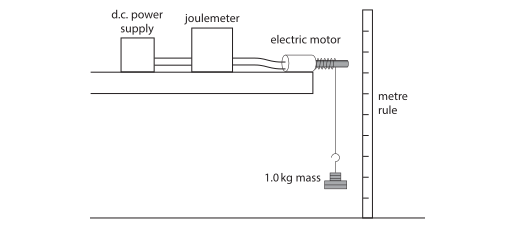
This is the student’s method.
- connect the electric motor to a d.c. power supply and a joulemeter
- attach a 1.0kg mass to the electric motor using a length of string
- set the voltage of the power supply to 10V and switch on the power supply
- switch off the power supply when the mass has been lifted through a distance of 50cm
- record the input energy to the motor from the joulemeter
- calculate the energy transferred to the gravitational store of the mass
- calculate the efficiency of the motor
The student repeats this process, setting the power supply to a different voltage each time.
The table shows the student’s results.
Power supply voltage
in V |
Joulemeter reading
in J |
Motor efficiency (%) |
| 3.0 | 99.4 | 5.0 |
| 3.5 | 25.5 | 19.6 |
| 4.0 | 16.5 | 30.3 |
| 5.0 | 13.5 | 37.0 |
| 6.0 | 12.6 | 39.7 |
| 8.0 | 12.8 | 39.1 |
| 10.0 | 12.7 | |
Using the graph, determine the minimum power supply voltage that will allow the electric motor to operate at maximum efficiency.
power supply voltage = V
Final answer
Power supply voltage = 6.0 V
Mark scheme points
- M1 Correctly reads the minimum voltage from the graph that gives the maximum efficiency. Acceptable range: 5.4 V to 6.6 V.
Explanation
The efficiency increases as the voltage increases, then reaches its maximum and becomes approximately constant. The minimum voltage at the start of this flat section is about 6.0 V.
Common mistakes
- Do not choose the highest voltage shown; the question asks for the minimum voltage giving maximum efficiency.
- Do not use the voltage at which the efficiency is still rising, such as 4 V or 5 V.
- Read the voltage where the curve first becomes flat, rather than reading the efficiency value from the vertical axis.
- Examiners reported that many candidates drew the correct flat section above about 6 V, but the data point at 30.3% caused confusion; read each plotted value carefully before judging where the curve levels off.
Practise Energy resources and energy transfers units questions
Build a focused practice set from this part of the Edexcel IGCSE Physics syllabus.