Edexcel IGCSE Physics revision

Edexcel IGCSE Physics Work and power questions

Revise the syllabus content for Work and power, learn how to approach common exam questions, and study two worked examples with clear diagrams.

Edexcel IGCSE Physics Subtopic 4.c

Work and power syllabus

Questions on work and power can test recall, calculations, explanations, diagrams, data handling and practical skills. You should be able to:

  • 4.11 know and use the relationship between work done, force and distance moved in the direction of the force: work done = force × distance moved W = F × d
  • 4.12 know that work done is equal to energy transferred
  • 4.13 know and use the relationship between gravitational potential energy, mass, gravitational field strength and height: gravitational potential energy = mass × gravitational field strength × height GPE = m × g × h
  • 4.14 know and use the relationship: kinetic energy = 1/2 × mass × speed² KE = 1/2 × m × v²
  • 4.15 understand how conservation of energy produces a link between gravitational potential energy, kinetic energy and work
  • 4.16 describe power as the rate of transfer of energy or the rate of doing work
  • 4.17 use the relationship between power, work done (energy transferred) and time taken: power = work done / time taken P = W / t

How to answer work and power questions

  1. Name the energy stores at the start and end and state the pathway that transfers energy.
  2. Separate useful output from wasted output when calculating or explaining efficiency.
  3. Show the equation, substitution and unit for work, power and energy calculations.
  4. When evaluating resources, compare reliability, environmental effects, cost and response time.

Work and power example questions and worked answers

These examples show how information in a diagram, graph or experimental context becomes part of a complete exam answer.

Example 1: Using a Diagram

Question 1
27
*P45691RA02736*
28
*P45691RA02836*
29
*P45691RA02936* Turn over
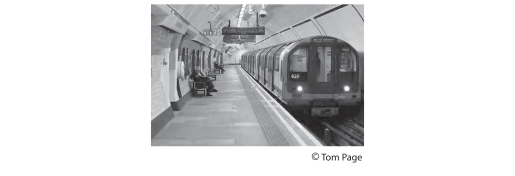
An underground train enters a station.
© Tom Page
Photograph of an underground train entering or at a station platform.
Turn over
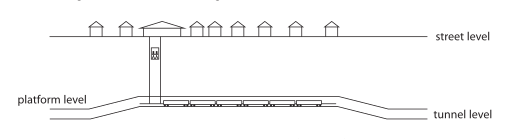
The diagram shows a section through the station.
Cross-section diagram of station showing street level at the top, platform level below, and tunnel level lower; a lift connects platform level to street level; tunnels slope up into the station and slope down out of it.
The tunnel is designed so that the trains go up a slope as they enter the station and go down a slope as they leave.
The driver uses brakes to stop the train in the station and a motor to make the train move away.
Explain how the sloping parts of the tunnel affect the amount of work that needs to be done on the train by the brakes and by the motor.

Final answer

As the train enters, it travels uphill, so some of its kinetic energy is transferred to gravitational potential energy. Therefore, the brakes do less work to stop the train.

As the train leaves, it travels downhill, so gravitational potential energy is transferred to kinetic energy. Therefore, the motor does less work to accelerate the train.

Mark scheme points

Any four valid points can score, with no more than three points from either list.

  1. M1 When entering, kinetic energy is transferred to gravitational potential energy.
  2. M2 Less work is done by the brakes to stop the train.
  3. M3 Less braking force is needed.
  4. M4 The train stops more quickly, or the brakes are needed for less time.
  5. M5 When leaving, gravitational potential energy is transferred to kinetic energy.
  6. M6 Less work is done by the motor to accelerate the train.
  7. M7 Less force is needed from the motor.
  8. M8 The train accelerates more quickly, or the force is needed for less time to reach a given speed.

Explanation

On the uphill section, gravity opposes the train’s motion. The train gains gravitational potential energy, so the brakes need to remove less kinetic energy. This means less work, and possibly less braking force or braking time.

On the downhill section, gravity helps the train’s motion. Gravitational potential energy is converted into kinetic energy, so the motor supplies less energy to produce the required acceleration. Consequently, the motor does less work and may need to provide less force for less time.

Common mistakes

  • Reversing the energy transfers: uphill is kinetic energy to gravitational potential energy; downhill is gravitational potential energy to kinetic energy.
  • Saying that the brakes or motor do more work without explaining the energy transfer caused by the slope.
  • Describing only a smaller force or shorter time without stating that less work is done.
  • Forgetting to discuss both entering the station and leaving the station.
Example 2: Using a Diagram

Question 2

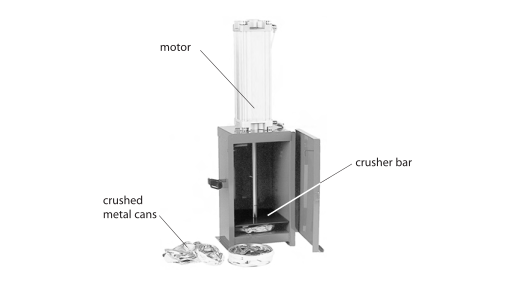
The photograph shows a machine used to crush metal cans. Photograph of a metal can crushing machine: a motor-driven crusher bar inside a cabinet; crushed metal cans are shown nearby. Labels indicate motor, crusher bar, and crushed metal cans. A metal can is placed under the crusher bar.
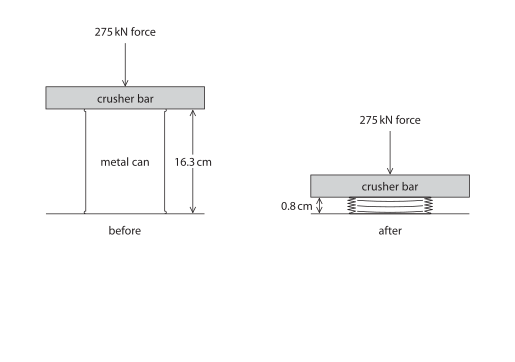
The motor pushes the crusher bar downwards.
The diagram shows what happens when a metal can is crushed. Diagram of can before and after crushing: a downward force of 275 kN acts on the crusher bar. Before crushing, the metal can height is 16.3 cm. After crushing, the can is compressed to 0.8 cm under the crusher bar. State the equation linking work done, force and distance moved in the direction of the force.

Final answer

W = F × d

Mark scheme points

  1. M1 Work done = force × distance moved in the direction of the force.

Explanation

Use the standard relationship:

W = F × d

Here, W is work done, F is the force, and d is the distance moved in the direction of the force.

Common mistakes

  • Do not write power = work done ÷ time; that is a different equation.
  • Include the multiplication sign or an equivalent rearrangement.
  • The distance must be the distance moved in the direction of the force.

Practise Work and power questions

Build a focused practice set from this part of the Edexcel IGCSE Physics syllabus.