Edexcel IGCSE Physics revision

Edexcel IGCSE Physics Energy transfers questions

Revise the syllabus content for Energy transfers, learn how to approach common exam questions, and study two worked examples with clear diagrams.

Edexcel IGCSE Physics Subtopic 4.b

Energy transfers syllabus

Questions on energy transfers can test recall, calculations, explanations, diagrams, data handling and practical skills. You should be able to:

  • 4.2 describe energy transfers involving energy stores: energy stores: chemical, kinetic, gravitational, elastic, thermal, magnetic, electrostatic, nuclear energy transfers: mechanically, electrically, by heating, by radiation (light and sound)
  • 4.3 use the principle of conservation of energy
  • 4.4 know and use the relationship between efficiency, useful energy output and total energy output: efficiency = useful energy output / total energy output × 100%
  • 4.5 describe a variety of everyday and scientific devices and situations, explaining the transfer of the input energy in terms of the above relationship, including their representation by Sankey diagrams
  • 4.6 describe how thermal energy transfer may take place by conduction, convection and radiation
  • 4.7 explain the role of convection in everyday phenomena
  • 4.8 explain how emission and absorption of radiation are related to surface and temperature
  • 4.9 practical: investigate thermal energy transfer by conduction, convection and radiation
  • 4.10 explain ways of reducing unwanted energy transfer, such as insulation

How to answer energy transfers questions

  1. Name the energy stores at the start and end and state the pathway that transfers energy.
  2. Separate useful output from wasted output when calculating or explaining efficiency.
  3. Show the equation, substitution and unit for work, power and energy calculations.
  4. When evaluating resources, compare reliability, environmental effects, cost and response time.

Energy transfers example questions and worked answers

These examples show how information in a diagram, graph or experimental context becomes part of a complete exam answer.

Example 1: Using a Diagram

Question 1

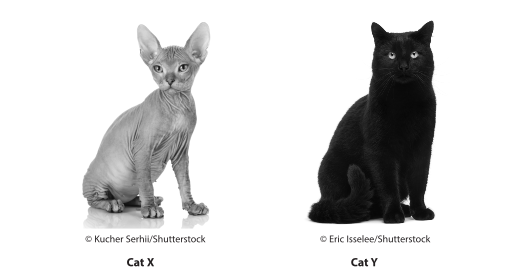
The photographs show two different breeds of cat.
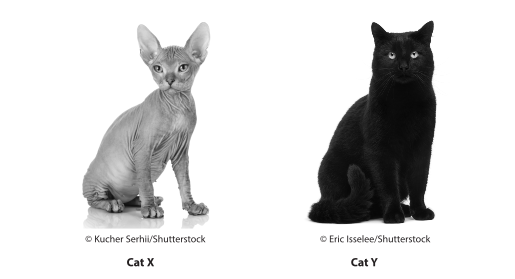
Photograph labelled Cat X: a cat with no fur and light-coloured skin. Photograph labelled Cat Y: a cat with thick, black fur.
Cat X has no fur and light-coloured skin.
Cat Y has thick, black fur.
Both cats have the same body temperature and transfer energy to their surroundings when they are outside on a cold day.
Compare how cat X and cat Y transfer energy to their surroundings.
Refer to conduction, convection and radiation in your answer.

Final answer

Cat X loses more energy by conduction and convection than cat Y. Cat Y’s fur traps air. Air and fur are poor conductors, so conduction is reduced. The trapped air cannot move around, so convection is also reduced.

Cat Y loses more energy by radiation than cat X because its black fur is a better emitter and emits radiation faster than the light-coloured skin of cat X.

Mark scheme points

Any six of the following points earn the available marks:

  1. M1 Cat X loses more energy by conduction or convection than cat Y.
  2. M2 Cat Y loses more energy by radiation than cat X.
  3. M3 Cat Y’s fur traps air.
  4. M4 A larger surface area increases conduction losses.
  5. M5 Air is a poor conductor or a good insulator.
  6. M6 Fur is a poor conductor or a good insulator.
  7. M7 Trapped air cannot move around.
  8. M8 Trapped air reduces convection.
  9. M9 Black surfaces are better emitters or emit radiation faster.

Explanation

Start by comparing the two cats for each energy-transfer method:

  • Conduction: cat Y has insulating fur and trapped air, both of which are poor conductors. Therefore, cat X loses more energy by conduction.
  • Convection: the air trapped in cat Y’s fur cannot circulate freely, so convection is reduced. Therefore, cat X loses more energy by convection.
  • Radiation: both cats have the same temperature, but cat Y has a black surface. Black surfaces are better emitters, so cat Y loses more energy by radiation.

Common mistakes

  • Do not only state that fur traps air; explain that air is a poor conductor and reduces conduction.
  • Do not say trapped air increases convection. It cannot move around freely, so convection is reduced.
  • Do not reverse the radiation comparison: black surfaces emit radiation better than light-coloured surfaces.
  • Do not discuss black surfaces being better absorbers, because the cats are transferring energy to their surroundings.
  • Examiners reported that many candidates knew fur traps air, but fewer explained that air is a poor conductor or that trapped air reduces conductive losses.
Example 2: Working With Graphs

Question 2

Penguins are adapted to survive in cold conditions.
The adaptations help them to maintain a constant body temperature of 39 °C.
Penguins also crowd together in groups of many penguins. A student wants to investigate how the temperature of a penguin is affected when they crowd together in groups.
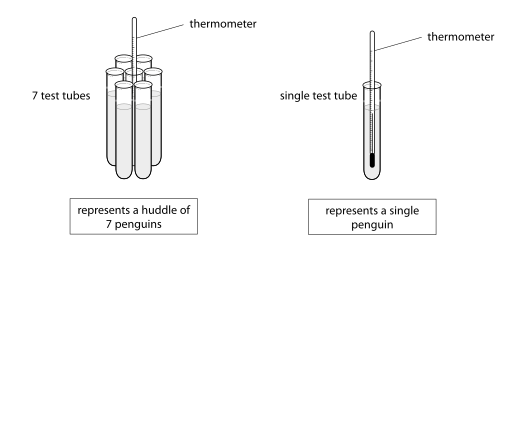
She uses this apparatus.
Each test tube represents a penguin. Apparatus diagram: a bundle of 7 test tubes tied together representing a huddle of 7 penguins with a thermometer in the middle test tube; and a single test tube representing a single penguin with a thermometer. Draw a sketch graph of the results you predict the student will obtain.
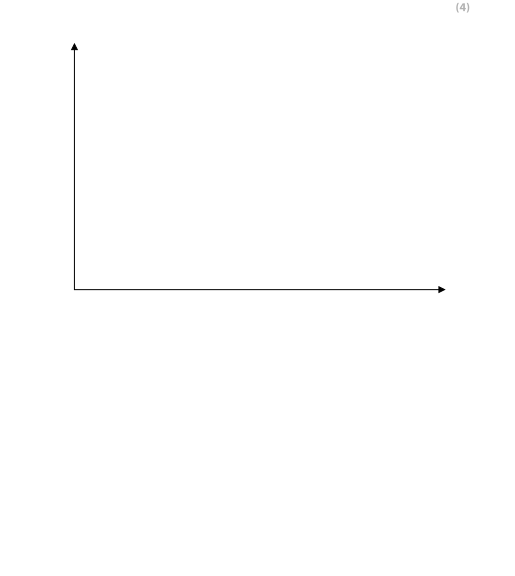
Label and use the axes below. Blank axes provided for sketch graph (no scale shown): vertical axis and horizontal axis for predicted results.

Final answer

See sketch graph.

huddle single time temperature

Mark scheme points

  1. M1 The horizontal axis is labelled time and the vertical axis is labelled temperature.
  2. M2 Both lines start on the vertical axis at the same temperature.
  3. M3 Both lines show temperature decreasing as time increases.
  4. M4 The line for the single penguin is below the line for the huddle at later times.

Explanation

Plot temperature on the vertical axis and time on the horizontal axis. Initially, both test tubes represent penguins at the same temperature, so the two lines must begin at the same point on the vertical axis.

As time passes, both penguins lose thermal energy, so both temperatures decrease. The huddle loses thermal energy more slowly because crowding reduces the exposed surface area. Therefore, its line remains above the line for the single penguin. The lines do not need a numerical scale.

Common mistakes

  • Putting time on the vertical axis and temperature on the horizontal axis.
  • Starting the two lines at different temperatures.
  • Drawing temperature increasing with time instead of decreasing.
  • Putting the single-penguin line above the huddle line; the single penguin should cool faster.

Practise Energy transfers questions

Build a focused practice set from this part of the Edexcel IGCSE Physics syllabus.