Edexcel IGCSE Physics revision

Edexcel IGCSE Physics Magnetism and electromagnetism units questions

Revise the syllabus content for Magnetism and electromagnetism units, learn how to approach common exam questions, and study two worked examples with clear diagrams.

Edexcel IGCSE Physics Subtopic 6.a

Magnetism and electromagnetism units syllabus

Questions on magnetism and electromagnetism units can test recall, calculations, explanations, diagrams, data handling and practical skills. You should be able to:

  • 6.1 use the following units: ampere (A), volt (V) and watt (W)

How to answer magnetism and electromagnetism units questions

  1. Write the unit symbol exactly and distinguish quantities that use similar-looking units.
  2. Convert prefixes and compound units before substituting values into an equation.
  3. Check that the unit of the final answer matches the quantity asked for.
  4. Use the context of a diagram or calculation to reject units with the wrong dimensions.

Magnetism and electromagnetism units example questions and worked answers

These examples show how information in a diagram, graph or experimental context becomes part of a complete exam answer.

Example 1: Using a Diagram

Question 1

*P44251A0316* Turn over
Answer ALL questions.

Electrical energy can be transmitted using a high voltage of 132 kV.

Photograph of an electricity pylon and overhead transmission lines in a field.

A voltage of 132 kV is the same as

A 132 V
B 1320 V
C 132 000 V
D 132 000 000 V

Final answer

C: 132 000 V

Mark scheme points

  1. M1 Selects C (132 000 V).

Explanation

The prefix kilo means 1000, so convert kilovolts to volts by multiplying by 1000.

132 kV = 132 × 1000 V
       = 132 000 V

Common mistakes

  • Do not treat kV as being equal to V; the prefix kilo means 1000.
  • Do not multiply by 10 or 100 instead of 1000.
  • Check that the unit in the answer is volts, V, not kilovolts, kV.
Example 2: Using a Diagram

Question 2

This is a question about a nuclear fusion power station.

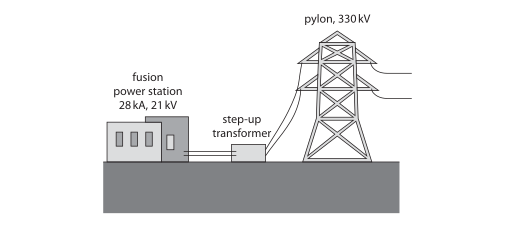
The diagram shows how a fusion power station could supply the National Grid in the future.

Diagram showing a fusion power station connected to a step-up transformer and then to a pylon for the National Grid. Labels indicate 28 kA, 21 kV at the fusion power station side and 330 kV at the pylon/output side.

The fusion power station could supply the input coil of the step-up transformer with a current of 28kA at a voltage of 21kV.

The output coil of the transformer has a voltage of 330kV.

Assume the transformer is 100% efficient.

Calculate the current in the output coil of the transformer.

current = kA

Final answer

Current = 1.8 kA

Mark scheme points

  1. M1 Substitute the values into VinIin = VoutIout.
  2. M2 Rearrange the equation to make Iout the subject.
  3. M3 Evaluate correctly to obtain 1.8 kA.

Explanation

For a transformer that is 100% efficient, the input power equals the output power:

VinIin = VoutIout

28 × 21 = 330 × Iout

Iout = (28 × 21) ÷ 330
Iout = 1.7818... kA
Iout ≈ 1.8 kA

The voltages are both in kV and the currents are both in kA, so the units are consistent. The output current is smaller because the transformer increases the voltage.

Common mistakes

  • Do not use the turns ratio equation when the question gives currents and asks about power.
  • Do not multiply by 330; rearrangement requires division by the output voltage.
  • Keep the current unit as kA, since the given input current is in kA.
  • Do not round too early: calculate 1.7818... before giving the final answer as 1.8 kA.

Practise Magnetism and electromagnetism units questions

Build a focused practice set from this part of the Edexcel IGCSE Physics syllabus.