Edexcel IGCSE Physics revision

Edexcel IGCSE Physics Magnetism questions

Revise the syllabus content for Magnetism, learn how to approach common exam questions, and study two worked examples with clear diagrams.

Edexcel IGCSE Physics Subtopic 6.b

Magnetism syllabus

Questions on magnetism can test recall, calculations, explanations, diagrams, data handling and practical skills. You should be able to:

  • 6.2 know that magnets repel and attract other magnets and attract magnetic substances
  • 6.3 describe the properties of magnetically hard and soft materials
  • 6.4 understand the term 'magnetic field line'
  • 6.5 know that magnetism is induced in some materials when they are placed in a magnetic field
  • 6.6 practical: investigate the magnetic field pattern for a permanent bar magnet and between two bar magnets
  • 6.7 describe how to use two permanent magnets to produce a uniform magnetic field pattern

How to answer magnetism questions

  1. Add arrows to field lines and distinguish magnetic field direction from force direction.
  2. State what changes in the field or conductor before explaining an induced voltage.
  3. Apply the left-hand rule systematically and describe how reversing current or field reverses force.
  4. For transformer calculations, label primary and secondary quantities before using the turns ratio.

Magnetism example questions and worked answers

These examples show how information in a diagram, graph or experimental context becomes part of a complete exam answer.

Example 1: Using a Diagram

Question 1

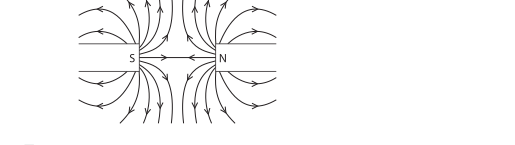
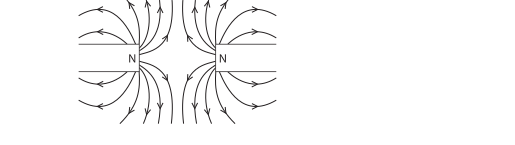
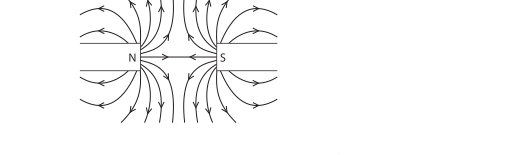
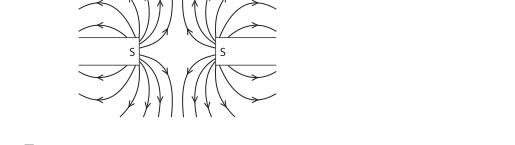
Which of these field patterns is correct?
A Option A: diagram of magnetic field lines around two bar magnets facing each other; both facing poles are labelled S; arrows on field lines shown.
B Option B: diagram of magnetic field lines around two bar magnets facing each other; left facing pole labelled S and right facing pole labelled N; arrows on field lines shown.
C Option C: diagram of magnetic field lines around two bar magnets facing each other; both facing poles are labelled N; arrows on field lines shown.
D Option D: diagram of magnetic field lines around two bar magnets facing each other; left facing pole labelled N and right facing pole labelled S; arrows on field lines shown.

Final answer

C — the two facing poles are both N poles.

S N N S

Mark scheme points

  1. M1 Selects C: two N poles are facing each other.

Explanation

Magnetic field lines outside a magnet travel from N to S. Like poles repel, so when two N poles face each other, the field lines bend away from the gap rather than joining across it. This is the pattern shown in option C.

Common mistakes

  • Choosing an option with two S poles simply because they are also like poles; the arrow directions must also be correct.
  • Forgetting that field lines leave a north pole and enter a south pole.
  • Choosing an unlike-pole pattern where the field lines join across the gap.
Example 2: Using a Diagram

Question 2

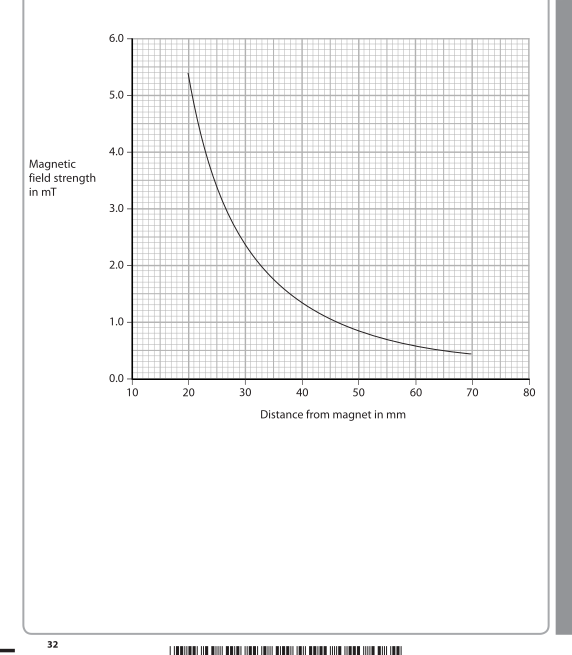
Magnetic field strength can be measured in units of milli-tesla (mT).
A student uses a different magnet.
The student measures the magnetic field strength at different distances from the north pole of this magnet.
The graph shows his results.
Graph of magnetic field strength (mT) against distance from magnet (mm), showing a decreasing curve as distance increases. The student concludes that his results obey this relationship.
magnetic field strength × distance2 = constant
Use data from the graph to deduce whether the student’s results support this conclusion.


Final answer

Yes. For example:

At d = 30 mm, B = 2.3 mT:
B × d² = 2.3 × 30² = 2070 mT mm²

At d = 50 mm, B = 0.8 mT:
B × d² = 0.8 × 50² = 2000 mT mm²

The values are approximately the same, so the results support the conclusion.

Mark scheme points

  1. M1 Correctly read one pair of values from the graph.
  2. M2 Correctly substitute the first pair of values into \(B \times d^2\) to calculate the constant.
  3. M3 Use a different pair of readings correctly to calculate a second value of the constant.
  4. M4 State that the two values are approximately the same, so the results support the conclusion.

Explanation

Choose two clearly separated points on the curve, rather than using the same reading twice. Read the magnetic field strength \(B\) and distance \(d\) for each point, then calculate \(B \times d^2\) for both.

The first pair gives \(2070\ \text{mT mm}^2\), while the second gives \(2000\ \text{mT mm}^2\). These are close enough to be approximately equal, allowing for the uncertainty in reading values from the graph. Therefore, the graph supports the relationship \(B \times d^2 = \text{constant}\).

Common mistakes

  • Giving only “yes” or “no” without quoting any readings from the graph.
  • Using the same pair of readings for both calculations instead of two different pairs.
  • Forgetting to square the distance: calculate \(B \times d^2\), not \(B \times d\).
  • Just over half of candidates scored all the marks, while many scored zero because they made no reference to the data; always include numerical readings and calculations.

Practise Magnetism questions

Build a focused practice set from this part of the Edexcel IGCSE Physics syllabus.