Edexcel IGCSE Physics Properties of waves questions
Revise the syllabus content for Properties of waves, learn how to approach common exam questions, and study two worked examples with clear diagrams.
EdexcelIGCSEPhysicsSubtopic 3.b
Properties of waves syllabus
Questions on properties of waves can test recall, calculations, explanations, diagrams, data handling and practical skills. You should be able to:
3.2 explain the difference between longitudinal and transverse waves
3.3 know the definitions of amplitude, wavefront, frequency, wavelength and period of a wave
3.4 know that waves transfer energy and information without transferring matter
3.5 know and use the relationship between the speed, frequency and wavelength of a wave: wave speed = frequency × wavelength v = f × λ
3.6 use the relationship between frequency and time period: frequency = 1 / time period f = 1 / T
3.7 use the above relationships in different contexts, including sound waves and electromagnetic waves
3.8 explain why there is a change in the observed frequency and wavelength of a wave when its source is moving relative to an observer and that this is known as the Doppler effect
3.9 explain that all waves can be reflected and refracted
How to answer properties of waves questions
Label wavelength, amplitude, frequency and normal lines before interpreting a diagram.
Use a ruler for ray diagrams and measure angles from the normal, not the surface.
Keep wave properties separate from applications and link each hazard to a suitable precaution.
For calculations, convert frequencies and distances before using wave speed relationships.
Properties of waves example questions and worked answers
These examples show how information in a diagram, graph or experimental context becomes part of a complete exam answer.
Example 1: Using a Diagram
Question 1
A student investigates different properties of waves.
Turn over
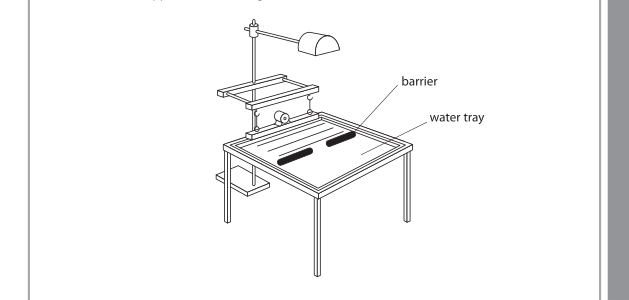
He uses this ripple tank to investigate diffraction.
The ripple tank produces plane waves.
These waves hit a barrier with a gap in it.
The student keeps the wavelength constant but varies the size of the gap in the barrier.
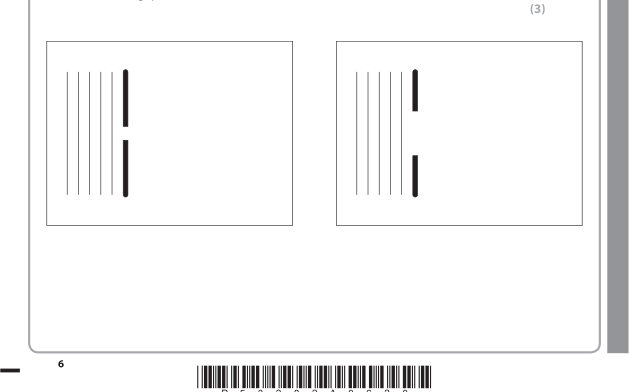
Complete the diagrams to show what happens to the plane waves as they go through the different sized gaps in the barrier.
Final answer
Draw the diffracted wavefronts as follows.
Narrow gap: semicircular wavefronts centred on the gap, with the same spacing as the incoming waves.
Wide gap: evenly spaced, mostly straight wavefronts, with curvature only at the edges.
Mark scheme points
M1 At least three correctly curved wavefronts are drawn, centred on the narrow gap.
M2 The spacing of the wavefronts is consistent with the spacing of the original plane wavefronts.
M3 For the wide gap, the wavefronts are evenly spaced and planar, with curvature at the edges.
Explanation
Diffraction is greatest when the gap is narrow compared with the wavelength. The wavefronts spread out as semicircles from the gap. When the gap is wide, there is much less spreading, so the central parts of the wavefronts remain straight and parallel.
For the narrow gap, draw at least three curved wavefronts with a common centre at the gap.
Keep the distance between successive wavefronts unchanged: this represents the wavelength being constant.
For the wide gap, draw evenly spaced straight wavefronts across the opening, bending only near their ends.
Common mistakes
Drawing the same semicircular pattern for both gaps; the wide gap should produce mainly planar wavefronts.
Changing the spacing between wavefronts after the gap, even though the wavelength is constant.
Drawing fewer than three curved wavefronts for the narrow gap.
Making an outgoing wavefront as long as the original incoming wavefront; only the relevant region after the gap is needed.
Example 2: Using a Diagram
Question 2
13
*P48444A01332* Turn over
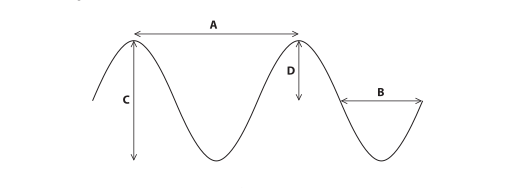
The diagram shows a transverse wave.
Which letter represents the amplitude of the wave?
A
B
C
D
Final answer
D
Mark scheme points
M1 D
Explanation
Amplitude is the maximum vertical displacement of the wave from its equilibrium position. Distance D shows this displacement from the equilibrium line to a crest.
A represents the wavelength.
B represents half the wavelength.
C is the distance from crest to trough, which is twice the amplitude.
Common mistakes
Choosing a horizontal distance: amplitude is measured vertically, not along the direction of travel.
Choosing the crest-to-trough distance: this is twice the amplitude, not the amplitude.
Confusing amplitude with wavelength, which is the horizontal distance between equivalent points on successive waves.
Practise Properties of waves questions
Build a focused practice set from this part of the Edexcel IGCSE Physics syllabus.
 Which letter represents the amplitude of the wave?