Edexcel IGCSE Biology revision

Cell structure questions

Identify cell structures, explain their functions and calculate magnification with consistent units.

Edexcel IGCSE Biology Subtopic 2.b

Cell structure syllabus

Questions on cell structure can test recall, calculations, explanations, diagrams, data handling and practical skills. You should be able to:

  • 2.2 describe cell structures, including the nucleus, cytoplasm, cell membrane, cell wall, mitochondria, chloroplasts, ribosomes and vacuole.
  • 2.3 describe the functions of each of these cell structures.
  • 2.4 compare the structures of plant and animal cells.
  • 2.5B explain the importance of cell differentiation in the development of specialised cells.
  • 2.6B explain the advantages and disadvantages of using stem cells in medicine.

How to answer cell structure questions

  1. Name the structure or process precisely before describing its biological role.
  2. When comparing cells, give paired differences and link each adaptation to its function.
  3. For microscopy and transport calculations, show the equation, unit conversion and substitution.
  4. In practical questions, identify the independent, dependent and controlled variables before interpreting results.

Cell structure example questions and worked answers

These examples show how information in a diagram, graph or experimental context becomes part of a complete exam answer.

Example 1: Labelling a leaf cell

Adapted from January 2013, Paper 1B · Question 4(b)

Question 1

The photograph shows a variegated leaf. The dark (green) part of the leaf has cells that contain chloroplasts. The white part of the leaf has cells that do not contain chloroplasts.

Photograph of a variegated leaf with a dark green central region and lighter areas around it.

The diagram shows a leaf cell from the green part of the leaf.
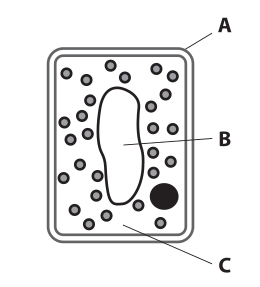
Leaf cell diagram with a thick outer boundary, a large central vacuole and many internal structures, labelled A, B and C.

Name the parts labelled A, B and C.

A

B

C

Final answer

A is the cell wall, B is the vacuole and C is the cytoplasm.

Mark scheme points

  1. M1 A: cell wall.
  2. M2 B: vacuole.
  3. M3 C: cytoplasm.

Explanation

A points to the cell’s thick outer boundary, which is the cell wall. B points to the large central vacuole. C points to the cytoplasm, the material inside the cell around its structures.

Common mistakes

  • Check that you identify the large central space as the vacuole, not the cytoplasm.
  • Use the label pointers to identify the structures; do not name a chloroplast just because the cell is from the green part of the leaf.

Example 2: Calculating magnification

Adapted from June 2021, Paper 1B · Question 1(b)

Question 2

The diagram shows a red blood cell viewed through a microscope.

Photograph of a red blood cell viewed through a microscope.

(Source: © Artem_Graf/Shutterstock)

The actual width of this red blood cell is 8 μm. In the original drawing, its width is 5.3 cm. Use this measurement, as the image size changes with your screen.

The magnification of this red blood cell can be calculated using this formula.

magnification = width of cell in drawingactual width of cell

Calculate the magnification of this red blood cell.

magnification =

Final answer

The cell is 5.3 cm wide in the drawing, which is 53 000 μm. Therefore, the magnification is 53 000 ÷ 8 = 6625.

Mark scheme points

  1. M1 Measure the cell width in the drawing as 5.0–5.4 cm.
  2. M2 Convert the measured width to μm and divide by the actual width, 8 μm. For a drawing width of 5.3 cm: 53 000 ÷ 8 = 6625. The correct answer alone is also accepted.

Explanation

Magnification is the drawing width divided by the actual width. Convert the drawing measurement into the same unit as the actual width before dividing.

Drawing width = 5.3 cm = 53 000 μm
Magnification = 53 000 μm ÷ 8 μm
              = 6625

Magnification has no units because the units cancel.

Common mistakes

  • Forgetting to convert centimetres to micrometres before calculating.
  • Multiplying by 8 instead of dividing the drawing width by the actual width.

Practise Cell structure questions

Build a focused practice set from this part of the Edexcel IGCSE Biology syllabus.