Edexcel IGCSE Biology revision

Respiration questions

Compare aerobic and anaerobic respiration, measure respiration rates and explain the effects of temperature.

Edexcel IGCSE Biology Subtopic 2.f

Respiration syllabus

Questions on respiration can test recall, calculations, explanations, diagrams, data handling and practical skills. You should be able to:

  • 2.34 understand how the process of respiration produces ATP in living organisms
  • 2.35 know that ATP provides energy for cells
  • 2.36 describe the differences between aerobic and anaerobic respiration
  • 2.37 know the word equation and the balanced chemical symbol equation for aerobic respiration in living organisms
  • 2.38 know the word equation for anaerobic respiration in plants and in animals
  • 2.39 practical: investigate the evolution of carbon dioxide and heat from respiring seeds or other suitable living organisms

How to answer respiration questions

  1. Trace the named substance through the relevant organs, tissues and cells in the correct order.
  2. Link structural adaptations to diffusion distance, surface area, concentration gradient or transport rate.
  3. Use balanced biological equations where required and distinguish respiration from breathing.
  4. When explaining a data trend, quote evidence and connect it to the underlying biological process.

Respiration example questions and worked answers

These examples show how information in a diagram, graph or experimental context becomes part of a complete exam answer.

Example 1: Obtaining reliable respirometer readings

Adapted from January 2020 (R), Paper 1B · Question 3(e)

Question 1

This apparatus can be used to measure the respiration rate of a small animal.
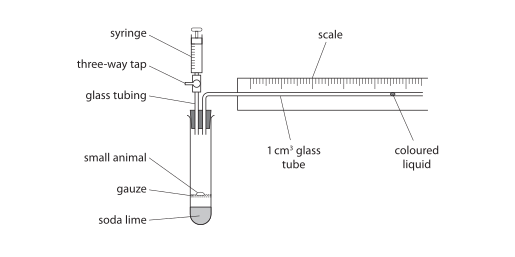
Respirometer apparatus with a syringe, three-way tap, glass tubing, small animal, gauze, soda lime, coloured liquid and a scale.

Explain how the apparatus should be used to obtain reliable data.

Final answer

Record the coloured liquid’s starting and final positions on the scale after a measured time, then find the distance it moved. Use the syringe to return the liquid to its starting position and repeat the measurement.

Mark scheme points

Award up to 3 marks for any 3 of these 4 points:

  1. M1 Measure or record the distance moved by the coloured liquid, using its starting and final positions on the scale.
  2. M2 Record the time taken for the liquid to move.
  3. M3 Use the syringe to reset the liquid to its starting position.
  4. M4 Repeat the measurement.

Explanation

The movement of the coloured liquid along the scale shows a change in gas volume as the animal respires. Recording the distance moved and the time allows the respiration rate to be assessed. Resetting the liquid with the syringe gives a fresh starting position, and repeating the measurement helps check that the result is reliable.

Common mistakes

  • The examiner report noted that only stronger candidates clearly referred to measuring the liquid’s movement and/or resetting it with the syringe. State these actions explicitly rather than just saying to measure respiration.
Example 2: Explaining yeast respiration at two temperatures

Adapted from June 2023 (R), Paper 1B · Question 4(b)(v)

Question 2

Yeast is a fungus that can respire anaerobically.

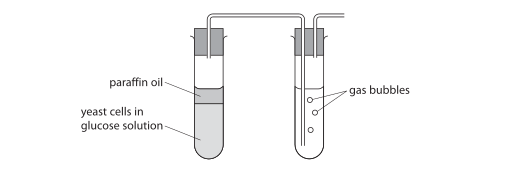
A student uses this apparatus to investigate the effect of temperature on anaerobic respiration by yeast.

Apparatus showing yeast cells in glucose solution covered by paraffin oil, connected to a second tube where gas bubbles are visible.

This is the student’s method.

  • place yeast cells and glucose solution into a test tube
  • keep the test tube at a temperature of 25°C
  • cover the yeast and glucose solution with paraffin oil
  • count the number of bubbles produced each minute for 20 minutes
  • repeat at a temperature of 37°C

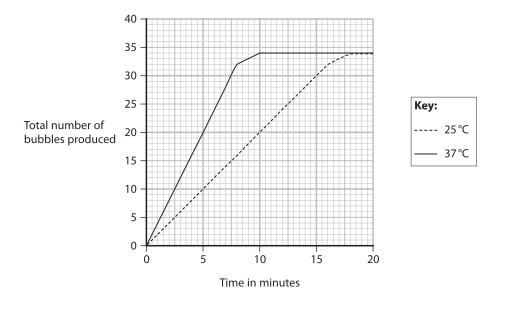
The student draws a graph to show the total number of bubbles that have been produced by the end of each minute for the 20-minute period.

The graph shows the student’s results.

Graph of total number of bubbles produced against time in minutes, showing curves for 25°C and 37°C.

Explain the difference in the rate of bubble production between 0 and 10 minutes at 37°C compared with 25°C.

Final answer

From 0 to 10 minutes, bubble production increases faster at 37°C than at 25°C because the particles have more kinetic energy and move faster, causing more frequent collisions between enzymes and substrates. This increases the rate of respiration. At 37°C, the glucose is also used up sooner, so bubble production levels off sooner.

Mark scheme points

Any three of these four points are needed:

  1. M1 Respiration, and therefore bubble production, is faster at 37°C.
  2. M2 At 37°C, particles have more kinetic energy or move faster. Being closer to the enzyme optimum is also accepted.
  3. M3 There are more or faster collisions between enzymes and substrates, or more enzyme-substrate complexes form.
  4. M4 At 37°C, the glucose runs out sooner or starts to limit respiration.

Explanation

The faster rise in bubbles shows that respiration is faster at 37°C. At the higher temperature, particles move faster because they have more kinetic energy. This leads to more frequent collisions between enzymes and substrates, increasing the rate of respiration and carbon dioxide production. The glucose is then used up sooner, so the graph levels off sooner.

Common mistakes

  • The examiner report notes that describing the graph without explaining the change in rate gained no credit. Link the higher temperature to increased kinetic energy and enzyme-substrate collisions.
  • Rate is shown by how steeply the total number of bubbles rises; do not confuse this with the total number of bubbles produced.

Practise Respiration questions

Build a focused practice set from this part of the Edexcel IGCSE Biology syllabus.