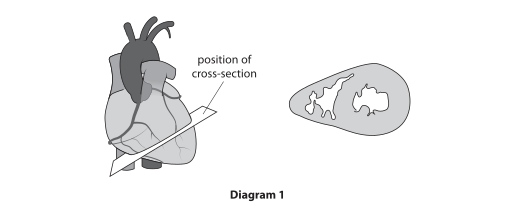
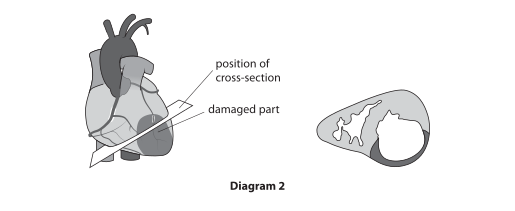
Example 1: Evaluating a transpiration experiment
Adapted from June 2019, Paper 2B · Question 2(c)
Question 1
A student uses this method to investigate the role of leaves in transpiration.
- remove four leaves from a plant
- cover the upper surface of one leaf with petroleum jelly
- cover the lower surface of one leaf with petroleum jelly
- cover both surfaces of one leaf with petroleum jelly
- keep one leaf uncovered
- measure the mass of each leaf
- suspend the leaves for several hours in air
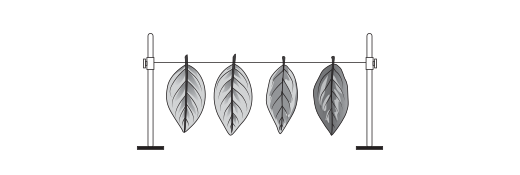
After several hours, the student measures the mass of each leaf again.
The graph shows his results.
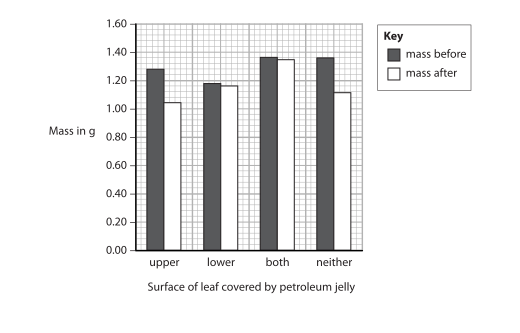
The student concludes that transpiration occurs mainly from the upper surface of leaves. Evaluate this conclusion.
Final answer
I disagree with the conclusion. The leaf with its upper surface covered loses more mass than the leaf with its lower surface covered, so most mass is lost from the lower surface. Stomata are found on the lower surface.
Mark scheme points
- M1 States that mass is lost from the lower surface or when the upper surface is covered; alternatively, little or least mass is lost from the upper surface or when the lower surface is covered.
- M2 States that stomata are on the lower surface, or that there are few or no stomata on the upper surface.
- M3 Disagrees with the student's conclusion.
Explanation
Compare the decrease in mass for the leaves: more mass is lost when the upper surface is covered than when the lower surface is covered. This indicates that most mass is lost from the exposed lower surface. Stomata, through which water vapour leaves the leaf during transpiration, are mainly on the lower surface. Therefore, the results do not support the student's conclusion that transpiration occurs mainly from the upper surface.
Common mistakes
- The examiner report notes that candidates often struggled to describe the results: refer to mass lost and identify the lower surface (or the leaf with its upper surface covered), rather than writing only about water loss.