Level of organisation syllabus
Questions on level of organisation can test recall, calculations, explanations, diagrams, data handling and practical skills. You should be able to:
- 2.1 describe the levels of organisation in organisms: organelles, cells, tissues, organs and systems
How to answer level of organisation questions
- Name the structure or process precisely before describing its biological role.
- When comparing cells, give paired differences and link each adaptation to its function.
- For microscopy and transport calculations, show the equation, unit conversion and substitution.
- In practical questions, identify the independent, dependent and controlled variables before interpreting results.
Level of organisation example questions and worked answers
These examples show how information in a diagram, graph or experimental context becomes part of a complete exam answer.
Adapted from January 2019, Paper 1B · Question 5(a)
Question 1
Pneumoconiosis is a lung disease caused by breathing in coal dust particles.
The X-ray shows the lungs of a person with pneumoconiosis.
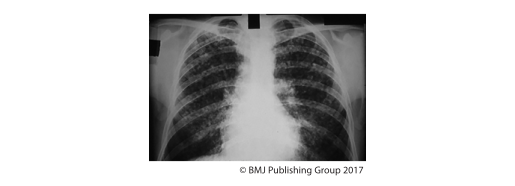
Coal dust particles collect in the alveoli and cannot be removed.
Cells grow around these coal dust particles, forming tissue that traps the particles.
State what is meant by the term tissue.
Final answer
A tissue is a group of similar cells that work together to carry out the same specific function.
Mark scheme points
- M1 Similar or same-type cells carry out the same, specific, or particular function.
Explanation
For the mark, include both ideas: the cells are similar or the same type, and they carry out the same function.
Common mistakes
- Do not define a tissue only as a group of cells; state that the cells are similar and carry out the same function.
Adapted from June 2016 (R), Paper 1B · Question 2(a)
Question 2
A student uses a microscope to look at some cells from an organ found in a plant.
The diagram shows what the student observes through the microscope. One cell has been labelled X.
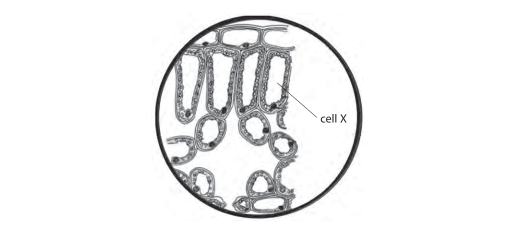
Name the organ that the student observes.
Mark scheme points
- M1 Name the organ as a leaf.
Explanation
The elongated palisade cells and the irregular cells with air spaces are characteristic tissues in a leaf. The question asks for the organ, so the answer is leaf.
Common mistakes
- Do not name a cell type or tissue, such as a palisade cell; the question asks for the organ.
Practise Level of organisation questions
Build a focused practice set from this part of the Edexcel IGCSE Biology syllabus.