Edexcel IGCSE Biology revision

Nutrition questions

Explain photosynthesis, digestion and balanced diets, and connect practical observations to the biology behind them.

Edexcel IGCSE Biology Subtopic 2.e

Nutrition syllabus

Questions on nutrition can test recall, calculations, explanations, diagrams, data handling and practical skills. You should be able to:

  • 2.18 understand the process of photosynthesis and its importance in the conversion of light energy to chemical energy
  • 2.19 know the word equation and the balanced chemical symbol equation for photosynthesis
  • 2.20 understand how varying carbon dioxide concentration, light intensity and temperature affect the rate of photosynthesis
  • 2.21 describe the structure of the leaf and explain how it is adapted for photosynthesis
  • 2.22 understand that plants require mineral ions for growth, and that magnesium ions are needed for chlorophyll and nitrate ions are needed for amino acids
  • 2.23 practical: investigate photosynthesis, showing the evolution of oxygen from a water plant, the production of starch and the requirements of light, carbon dioxide and chlorophyll Humans
  • 2.24 understand that a balanced diet should include appropriate proportions of carbohydrate, protein, lipid, vitamins, minerals, water and dietary fibre
  • 2.25 identify the sources and describe the functions of carbohydrate, protein, lipid (fats and oils), vitamins A, C and D, the mineral ions calcium and iron, water and dietary fibre as components of the diet
  • 2.26 understand how energy requirements vary with activity levels, age and pregnancy
  • 2.27 describe the structure and function of the human alimentary canal, including the mouth, oesophagus, stomach, small intestine (duodenum and ileum), large intestine (colon and rectum) and pancreas
  • 2.28 understand how food is moved through the gut by peristalsis
  • 2.29 understand the role of digestive enzymes, including the digestion of starch to glucose by amylase and maltase, the digestion of proteins to amino acids by proteases and the digestion of lipids to fatty acids and glycerol by lipases
  • 2.30 understand that bile is produced by the liver and stored in the gall bladder
  • 2.31 understand the role of bile in neutralising stomach acid and emulsifying lipids
  • 2.32 understand how the small intestine is adapted for absorption, including the structure of a villus 2.33B practical: investigate the energy content in a food sample

How to answer nutrition questions

  1. Trace the named substance through the relevant organs, tissues and cells in the correct order.
  2. Link structural adaptations to diffusion distance, surface area, concentration gradient or transport rate.
  3. Use balanced biological equations where required and distinguish respiration from breathing.
  4. When explaining a data trend, quote evidence and connect it to the underlying biological process.

Nutrition example questions and worked answers

These examples show how information in a diagram, graph or experimental context becomes part of a complete exam answer.

Example 1: Testing a variegated leaf for starch

Adapted from June 2023 (R), Paper 1B · Question 6(b)(ii)

Question 1

Variegated leaves have areas that are green and areas that are white.

A student uses this method to investigate the effect of light on photosynthesis in a variegated leaf.

  • place a plant in the dark for 24 hours
  • wrap a strip of black paper across a leaf
  • shine light on the plant for 24 hours
  • remove the black paper
  • use iodine solution to test the leaf for starch

The diagram shows the apparatus the student uses.
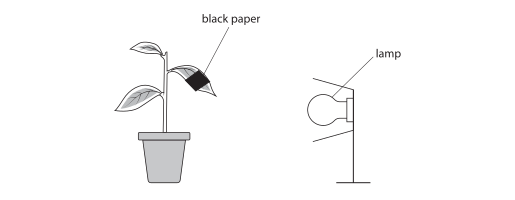
Diagram showing a plant with a strip of black paper across a leaf and a lamp beside it.

Diagram 1 shows the position of the black paper on the leaf.
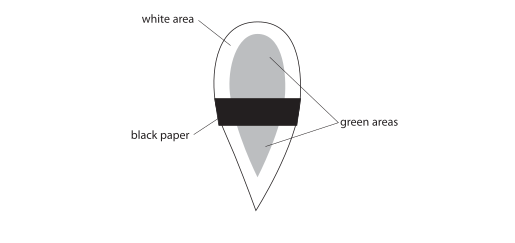
Diagram 1 of a variegated leaf with a horizontal strip of black paper across green and white areas.

Diagram 1

Complete diagram 2 to show where the variegated leaf would appear black after testing with iodine solution.
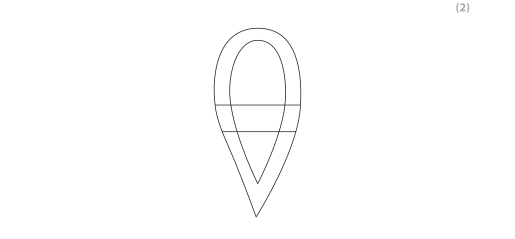
Blank outline of the variegated leaf for completion after testing with iodine solution.

Diagram 2

Final answer

Shade both green areas exposed to light, above and below the black paper. Leave the white areas and the whole strip previously covered by black paper unshaded.

Blue-black: starch present Unshaded: no starch Strip covered by black paper Originally white area: no starch

Mark scheme points

  1. M1 Shade both exposed green areas, leaving the areas with no green unshaded.
  2. M2 Leave the entire strip under the black paper unshaded. This mark is not awarded if the rest of the leaf is left blank.

Clear labels such as “black”, “starch” or “no starch” are accepted instead of shading.

Explanation

Iodine turns blue-black where starch is present. The initial period in darkness removes stored starch, so this test shows where starch has been made during the investigation.

  • The exposed green areas contain chlorophyll and receive light, so they photosynthesise and produce sugars that can be stored as starch. Shade both of these areas. The white areas lack chlorophyll, so leave them unshaded.
  • The black paper blocks light. Even the green parts beneath it cannot photosynthesise, so leave the whole covered strip unshaded.

Common mistakes

  • Some candidates shaded green areas beneath the paper. Check that every shaded area had both chlorophyll and light.
  • Leaving the whole leaf blank does not earn the mark for an unshaded covered strip: you must also show where starch is present.
Example 2: Measuring energy stored in plants

Adapted from June 2018, Paper 2B · Question 4(d)

Question 2

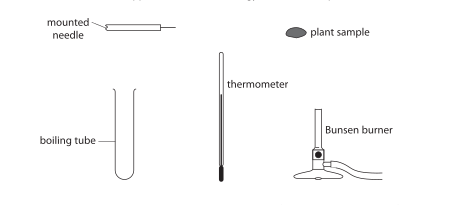
A student uses this apparatus to find the energy content of plants.

Apparatus labelled boiling tube, thermometer, plant sample mounted on a needle, and Bunsen burner.

Explain how the student could use this apparatus to find the energy content of the plants.

Final answer

Put a measured amount, for example 20 cm3, of water into the boiling tube and record its starting temperature. Weigh the plant sample, ignite it and hold it beneath the tube so it heats the water. Let it burn completely, relighting it if necessary, then record the water’s final temperature. Repeat the test and calculate an average. Calculate the energy transferred to the water from its temperature rise, then divide by the mass of plant burned to find the energy content per gram.

Mark scheme points

Five marks are available. Any five of these valid points can earn full marks.

  1. M1 Put a stated amount of water in the tube; include a numerical volume or mass, for example 20 cm3.
  2. M2 Hold the burning plant beneath the water.
  3. M3 Allow the plant to burn completely, relighting it if needed.
  4. M4 Measure the water temperature before and after burning.
  5. M5 Calculate energy transferred using temperature rise × mass of water × 4.2 (or use the volume of water).
  6. M6 Repeat the test and calculate an average.
  7. M7 Measure the mass of the plant sample and use it to calculate energy content per gram.

Explanation

The water absorbs some of the energy released as the plant burns. Record its temperature before and after heating to find the temperature rise. For 20 cm3 of water, its mass is approximately 20 g.

temperature rise = final temperature − starting temperature
energy transferred to water (J) = temperature rise (°C) × mass of water (g) × 4.2 J g⁻¹ °C⁻¹
energy content per gram = energy transferred to water (J) ÷ mass of plant burned (g)

Burning the sample completely helps ensure that its energy is released, and repeating the test and averaging helps make the result more reliable.

Common mistakes

  • Give a numerical amount of water, not just “some water”.
  • Use the temperature rise, not the final temperature alone, in the energy calculation.
  • To give energy content per gram, divide by the mass of plant burned.

Practise Nutrition questions

Build a focused practice set from this part of the Edexcel IGCSE Biology syllabus.