Example 1: Explaining binocular vision in predators
Adapted from January 2023, Paper 2B · Question 2(b)(iv)
Question 1
A student investigates if using one eye or using two eyes is better for judging the distance of objects. The student uses the plastic block shown in the diagram. The block has a grid where six different coloured pins can be placed as shown in the diagram.
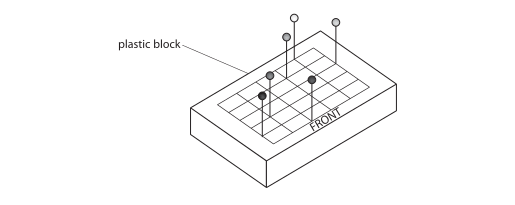
This is the student’s method.
- place one pin into the lines of each column and row so that each pin is a different distance from the front of the grid
- ask a volunteer to close one eye
- hold the grid in front of the volunteer so they can see the coloured pins but not the grid
- ask the volunteer to call out the colour of the pins in order of distance, from nearest to furthest
- record the number of pins that the volunteer identifies correctly
- repeat eight more times, each time moving the pins to different positions in the grid
The student does the experiment again with both eyes open.
After nine trials, the student summarises the number of correctly identified pins.
| Summary | Using one eye | Using both eyes |
|---|---|---|
| Mode | 3 | 6 |
| Median | 2 | 6 |
The field of view is the area that an animal can see with their eyes. The diagram shows the field of view for a cat.
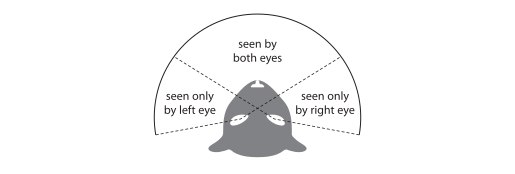
Explain why predators, such as cats, have two forward facing eyes. Use the information in the diagram and Table 2 to support your answer.
Final answer
The diagram shows a large area seen by both eyes. The results show better distance judgement with both eyes, as more pins were identified in the correct order. This helps a predator locate and catch its prey.
Mark scheme points
Any three of the following points are needed for three marks. The first three form the answer above.
- M1 A large area is seen by both eyes; the visual fields overlap.
- M2 Distance judgement is better with two eyes, supported by more pins identified correctly (or a higher mode or median) with both eyes.
- M3 Better distance judgement helps the predator locate, chase or catch prey.
- M4 Alternatively, predators do not need a wide field of view to see behind them because they are not usually preyed upon.
Explanation
The diagram shows that the forward-facing eyes have an overlapping region, so a large area is seen by both eyes. The table supports the advantage of using both eyes: the volunteer identified more pins in the correct distance order, showing better distance judgement. A predator can use this judgement to locate and catch prey.
Common mistakes
- Saying only that predators have a “larger field of view” is not enough: describe the overlapping area seen by both eyes.
- Most candidates scored at least one mark; stronger answers linked the area seen by both eyes to judging distance from prey. Make that link explicit rather than mentioning the field of view alone.